Essential Oils Studied For Anti-Inflammatory Properties

Studied for Anti-Inflamatory
Anti-Inflammatory means an agent that alleviates inflammation.

Basil Essential Oil
Basil is cooling to the skin, and can be used to soothe minor irritations. When diffused, Basil helps promote clear breathing, and healthy respiratory function while sharpening focus, and lessening stress.
Learn More

Bergamot Essential Oil

Italians have used Bergamot for years to reduce tension and stress and to soothe and rejuvenate skin. Bergamot is unique among citrus oils due to its ability to be both uplifting and calming, making it ideal to help with anxious and sad feelings.

Learn More

Cassia Essential Oil 


When diluted, Cassia can help soothe sore, achy joints. Cassia can be used in cooking either as a replacement for Cinnamon in pies and breads, or by itself in many different entrees and desserts.
Learn More

Eucalyptus Essential Oil

Eucalyptus oil is best known for respiratory health and works great when massaged over the chest and throat. Can be applied without diluting.
Learn More

Frankincense Essential Oil

Frankincense promotes a healthy inflammatory response and acts as an overall tonic to the body’s systems, helping them function optimally. When inhaled or diffused, Frankincense induces feelings of peace, relaxation, satisfaction, and overall wellness.
Learn More

Geranium Essential Oil

This oil has been used to promote clear skin and healthy hair, making it ideal for skin and hair care products. It also helps calm nerves and lessen stress.
Learn More

Helichrysum Essential Oil
Helichrysum is great for regenerative effects, can be used without dilution for most people. No first aide kit should be without this oil.
Learn More

Lavender Essential Oil
Inhaling Lavender promotes relaxation and a restful night’s sleep, making it an ideal oil to diffuse at bedtime and when stress levels are high.
Learn More

Lemongrass Essential Oil
This oil supports healthy digestion, and soothes aching muscles. Lemongrass purifies and tones skin, and acts as an overall tonic to the body’s systems.
Learn More

Myrrh Essential Oil

Myrrh is valued as an expectorant, which means it promotes the expulsion of mucus in cases of bronchitis and lung congestion. Myrrh is best for chronic conditions, because it contains tannins and resins, it has an astringent effect on tissues.
Learn More

Orange Essential Oil

Orange can be taken daily to cleanse the body or used on surfaces as a natural cleaner. Diffusing Wild Orange will energize and uplift the mind and body while purifying the air.
Learn More

Peppermint Essential Oil

Peppermint is very pleasing to the taste buds (you can add the oil to tea or water), but is powerfully soothing to the digestive system. You can usually apply it without diluting, inhale for nausea, or take internally as suggested.
Learn More

Roman Chamomile Essential Oil

Ancient Romans used the oil for mental clarity and courage during war. While the most common use of chamomile is in teas, Roman Chamomile can also be found in face creams, drinks, hair dyes, shampoos, and perfumes.
Learn More

Rosemary Essential Oil

Rosemary supports healthy digestion and helps soothe sore muscles and joints. This oil also helps reduce nervous tension and fatigue.
Learn More

Wintergreen Essential Oil

The main chemical component in Wintergreen, methyl salicylate, is used in topical joint creams to soothe sore muscles and joints; in fact, Wintergreen and Birch are the only plants in the world that contain methyl salicylate naturally.
Learn More
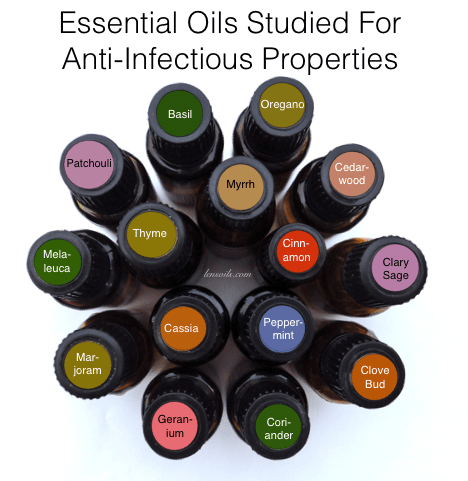
Essential Oils Studied For Anti-Infectious Properties

Anti-Infectious Properties
Anti-Infectious means an agent that prevents and combats the spread of germs.

Basil Essential Oil

Basil is cooling to the skin, and can be used to soothe minor irritations. When diffused, Basil helps promote clear breathing, and healthy respiratory function while sharpening focus, and lessening stress.
Learn More

Cassia Essential Oil
When diluted, Cassia can help soothe sore, achy joints. Cassia can be used in cooking either as a replacement for Cinnamon in pies and breads, or by itself in many different entrees and desserts.
Learn More

Cedarwood Essential Oil
Diffusing or inhaling Cedarwood will help maintain healthy breathing and respiratory function and, when applied topically, Cedarwood promotes clear, healthy skin.
Learn More

Cinnamon Essential Oil

Cinnamon is strong, so be sure to dilute it (3 drops of carrier oil to 1 drop of cinnamon), but you can cook, bake, or even make candy with it too.
Learn More

Clary Sage Essential Oil
The main chemical component of Clary Sage is linalyl acetate, part of the esters group, making it one of the most relaxing, soothing, and balancing essential oils.
Learn More

Clove Essential Oil

Clove has been used for years in dental preparations,candy, and gum for its flavor and ability to promote oral health, yet it provides a myriad of health benefits.
Learn More

Coriander Essential Oil
Coriander has a high linalool content, giving it strengthening and toning properties that benefit the skin, emotions, and body.
Learn More

Geranium Essential Oil

This oil has been used to promote clear skin and healthy hair, making it ideal for skin and hair care products. It also helps calm nerves and lessen stress.
Learn More

Marjoram Essential Oil
Marjoram oil is noted for it’s calming properties, can be taken internally, or used topically, although sensitive skin may want to dilute and it. One drop of essential oil is equivalent to 2 tsp. of dried herbs.
Learn More


Melaleuca Essential Oil
Melaleuca is best known for its purifying properties. It can be used to cleanse and purify. Taken internally, Melaleuca enhances immunity when seasonal threats are high.
Learn More


Myrrh Essential Oil

Myrrh is valued as an expectorant, which means it promotes the expulsion of mucus in cases of bronchitis and lung congestion. Myrrh is best for chronic conditions, because it contains tannins and resins, it has an astringent effect on tissues.
Learn More


Oregano Essential Oil
Oregano is one of the most potent essential oils. It must be diluted (3 drops of carrier oil to 1 drop of Oregano essential oil when used topically). Apply to reflex points. It can be used as a flavoring in cooking.
Learn More

Patchouli Essential Oil
Patchouli is regularly used in the perfume industry as well as in scented products. The fragrance of Patchouli provides a grounding, balancing effect on emotions.
Learn More

Peppermint Essential Oil

Peppermint is very pleasing to the taste buds (you can add the oil to tea or water), but is powerfully soothing to the digestive system. You can usually apply it without diluting, inhale for nausea, or take internally as suggested.
Learn More

Thyme Essential Oil

Thyme makes a great defense against many concerns, although it should always be diluted (4 drops carrier oil to 1 drop thyme). You can also cook with it.
Learn More

Essential Oils Studied For Anticatarrhal Properties

Studied for Anticatarrhal Properties
The term anticatarrhal refers to an agent that helps remove excess mucus from the respiratory system. The oils listed have been studied for properties that help dissolve and eliminate, as well as prevent the formation of mucus and inflammation of the mucus membrane.

Basil Essential Oil
Basil is cooling to the skin, and can be used to soothe minor irritations. When diffused, Basil helps promote clear breathing, and healthy respiratory function while sharpening focus, and lessening stress.
Learn More

Clove Essential Oil
Clove has been used for years in dental preparations,candy, and gum for its flavor and ability to promote oral health, yet it provides a myriad of health benefits.
Learn More

Eucalyptus Essential Oil
Eucalyptus oil is best known for respiratory health and works great when massaged over the chest and throat. Can be applied without diluting.
Learn More

Fennel Essential Oil
Fennel is best known for its distinct licorice aroma and taste, yet its ability to ease digestive troubles and monthly menstrual cycles are equally noteworthy.
Learn More

Frankincense Essential Oil
Frankincense is known to promote cellular health and immunity. It’s soothing and beautifying properties are used to rejuvenate skin and reduce the appearance of scars and stretch marks.
Learn More

Ginger Essential Oil
Ginger can lessen motion sickness, soothe an upset stomach, and help digest food after a large meal. Ginger essential oil can also be applied topically or inhaled to help with digestion issues.
Learn More

Helichrysum Essential Oil

Helichrysum is highly valued and sought after for its many health benefits. It’s frequently consumed to help detoxify the body.
Learn More

Marjoram Essential Oil
Marjoram oil is noted for it’s calming properties, can be taken internally, or used topically, although sensitive skin may want to dilute and it. One drop of essential oil is equivalent to 2 tsp. of dried herbs.
Learn More

Myrrh Essential Oil

Myrrh is valued as an expectorant, which means it promotes the expulsion of mucus in cases of bronchitis and lung congestion. Myrrh is best for chronic conditions, because it contains tannins and resins, it has an astringent effect on tissues.
Learn More

Oregano Essential Oil
Oregano is one of the most potent essential oils. It must be diluted (3 drops of carrier oil to 1 drop of Oregano essential oil when used topically). Apply to reflex points. It can be used as a flavoring in cooking.
Learn More

Peppermint Essential Oil
Peppermint is very pleasing to the taste buds (you can add the oil to tea or water), but is powerfully soothing to the digestive system. You can usually apply it without diluting, inhale for nausea, or take internally as suggested.
Learn More

Rosemary Essential Oil

Rosemary supports healthy digestion and helps soothe sore muscles and joints. This oil also helps reduce nervous tension and fatigue.
Learn More

Sandalwood Essential Oil

Sandalwood has a sweet, woody aroma that can enhance mood and is frequently used in meditation for its grounding effects.
Learn More


Thyme Essential Oil

Thyme makes a great defense against many concerns, although it should always be diluted (4 drops carrier oil to 1 drop thyme). You can also cook with it.
Learn More

White Fir Essential Oil
White Fir essential oil is most noted for soothing sore muscles and joints and supporting It can be stimulating to the mind while helping the body to relax. clear breathing.
Learn More

Geranium-Did You Know?

Geranium

Did you know Geranium is the oil of love, and trust? Geranium brings back the confidence, and the genuine goodness of others, and in the world. It helps bring about trust easier when a person has lost trust in others due to challenging life altering events. Geranium gives support with emotional honesty, love, and forgiveness when there has been a loss of trust with relationships.

Geraniums were discovered in South Africa, the first geranium plants quickly gained acceptance in England in the 17th century. But it wasn’t until Thomas Jefferson shipped the plant from France to America in 1786 that the plant gained popularity in American gardens.

Geranium essential oil is well-known for its deep positive effects on various skin disorders like acne, rashes, eczema, dermatitis, fungal infections, etc. The best thing about the Geranium essential oil is that it is a cicatrisant which means this oil has the ability to address wound issues. So, it can help scars fade away gradually and make our skin flawless.

The Geranium essential oil is a natural cleanser. It can be used directly onto the skin for cleaning or added to the water for bathing. You can have healthy radiant skin both ways. The astringent properties of geranium are also very beneficial for our skin. Our muscle contractions get significantly boosted with these. Consequently, we get a firm and toned look.

Cod Liver Oil Yuck!

Cod liver oil story

I have told this story several times to my children. When I was a child my mom would make homemade hot oatmeal cereal for breakfast. Then just before we would leave for school we would get a tablespoon of cod liver oil, because it is high in vitamin D. About an hour later I would be burping up this Oatmeal-cod liver oil flavor.

One morning I just couldn’t take it anymore just thinking about cod liver oil made me sick. I went into the bathroom and lost my breakfast after taking that disgusting stuff. From that day on, I never had to get a morning dose of cod liver. To this day I have a hard time eating hot oatmeal cereal for breakfast. At the time it was a terrible experience now I just laugh.

Growing up on a small farm I was raised on fresh, homemade, things for most of our meals. If we didn’t like what was made from any of our meals, we were told to go pick something out in the garden to eat.

Surprisingly enough there was usually something fresh in the garden nine months out of the year, from the carrots and potatoes to all kinds of fruit. I have always been taught that fresh uncooked fruits and vegetables are the most healthy. I love this advice. Remember whole grains not white flour. I Love making things homemade, or as we called it making things from scratch.

Fennel-Did You Know?

Fennel.png
Did you know fennel essential oil is the oil of responsibility? Fennel supports the person who has a lack of self esteem. This person may feel overwhelmed with life and all the things they are accountable for, having little to zero desire to improve their situation. Fennel is especially important by supporting people to listen and reconnect to the natural messages of the body, where there has been a loss of connection due to emotional eating, severe dieting and even drug abuse.

Fennel can grow up to six feet in height and has delicate, feathery leaves. Most fennel originated in India, Egypt and China. It also dates back to Pliny the Roman author of Naturalis Historie written between 23-79 AD. He used fennel for 22 different ailments. Roman warriors were said to have consumed Fennel to make them strong and ready for battle.

We know King Edward I of England consumed large amounts of fennel because his account book listed a purchase of 8½ pounds. This seed was a one month supply. In the 1300s fennel was used as a condiment and an appetite suppressant. During medieval times, people thought evil spirits could freely move around as the sun moved south. It was thought when fennel was hung over doorways you were protected from the spirits. Fennel seeds inserted into keyholes were thought to protect homes from ghosts especially in the summer.

Fennel is best known for its distinct licorice aroma and taste, yet its ability to ease digestive troubles, and monthly menstrual cycles are equally noteworthy. Fennel can be added to tea to calm the digestive system, as well as the mind and emotions. Fennel can be very soothing when applied to the abdomen during monthly menstrual cycles, and those same properties can lessen the discomfort associated with minor skin irritations. Fennel is also known to support a healthy lymphatic system.