Category Archives: Uncategorized

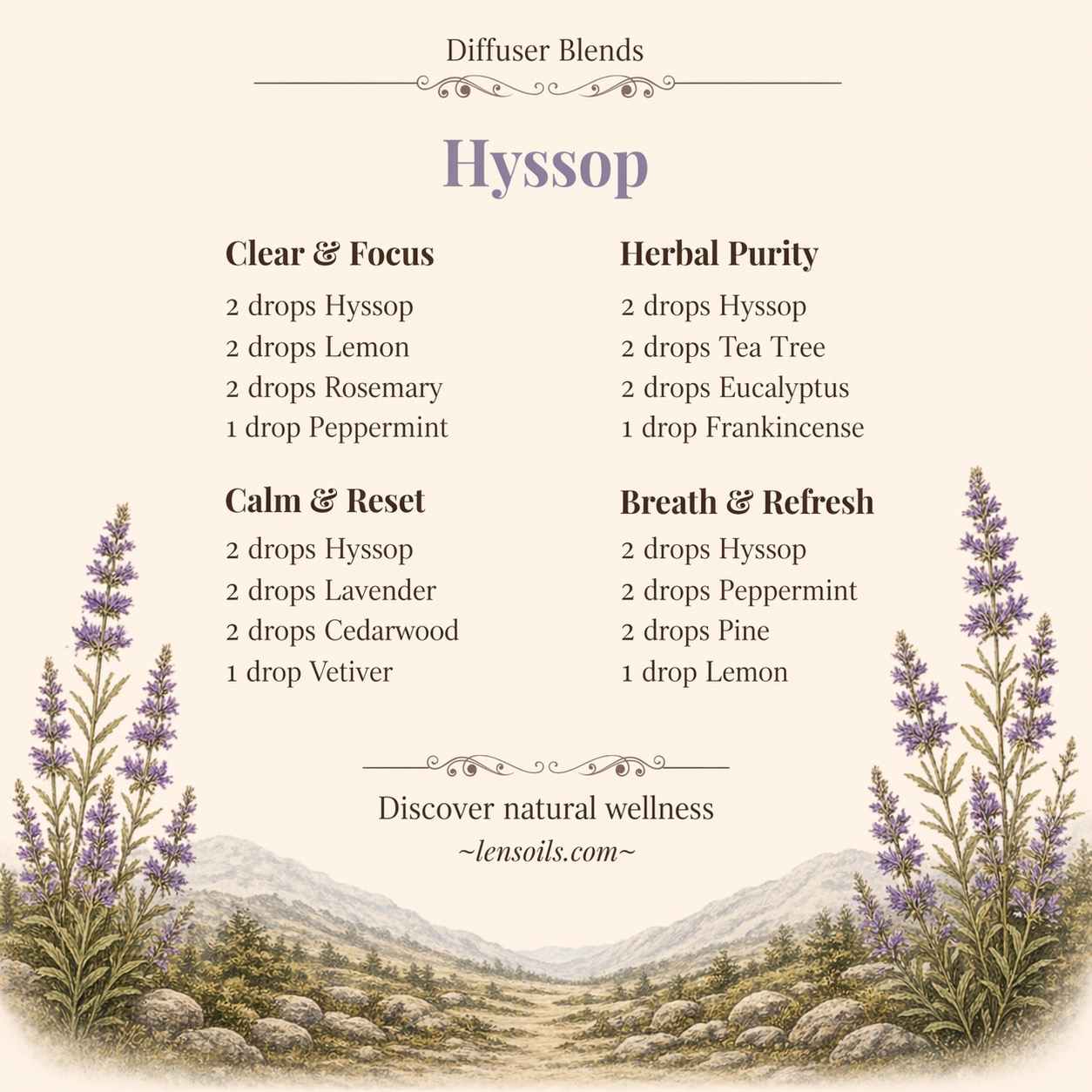
Essential Oil Diffuser Blends:

Hyssop diffuser blends tend to carry a crisp, herbal character that feels clean, bright, and slightly invigorating. Clear & Focus leans into that sharper profile with lemon, rosemary, and peppermint for a fresh, alert atmosphere, while Calm & Reset softens the edge with lavender, cedarwood, and vetiver for a more grounded, balanced feel. Herbal Purity emphasizes a clean, clearing tone with tea tree, eucalyptus, and frankincense, and Breath & Refresh opens things up with peppermint, pine, and lemon for a light, airy effect. Across all four, Hyssop provides a consistent thread—fresh, herbaceous, and quietly clarifying.

Emotionally, Hyssop’s aroma often feels like a mental reset, helping clear out that “foggy” or cluttered feeling and bringing a sense of renewed focus. It can support a feeling of openness and gentle clarity, especially when the mind feels scattered or overloaded. Rather than being heavy or deeply grounding, it tends to feel uplifting in a clean, natural way—like opening a window and letting in fresh air, helping everything feel a little more clear, steady, and refreshed.

Essential Oil Meme

Remember when I was really into essential oils? Yeah… turns out that was just the beginner phase—now it’s labels, sourcing, testing methods, and “just one more blend” at all hours.
The more you learn, the less casual it becomes, and suddenly you’re the person noticing every scent in the room thinking, “I know exactly what that needs.”

A Mother Goose Retelling with Essential Oils

Georgie Porgie

Georgie Porgie, pudding and pie,
Kissed the girls and made them cry;
When the boys came out to play,
Georgie Porgie ran away.

There was a report from the schoolyard shortly after recess began. Georgie, perhaps feeling bold from his pudding and pie, had been seen chasing the girls with more enthusiasm than manners. The laughter quickly turned to protest, and before long a teacher stepped in, placing a steady hand on Georgie’s shoulder. The scene shifted from mischief to accountability. The teacher knelt to eye level, reminding him that kindness carries more strength than bravado. The boys who had come out to play watched closely, and Georgie, no longer running, stood quietly as the lesson settled in.

From an essential oil standpoint, this is a moment for emotional reset rather than embarrassment. Lavender would help soften heightened feelings and calm the nervous system after being corrected. Cedarwood supports confidence without aggression, helping a child feel steady rather than defensive. Roman Chamomile is especially helpful for big emotions in small bodies, encouraging gentleness and empathy. As the playground 

Essential Oils in the Bible: Leviticus 2:15

In Book of Leviticus 2:15, the instruction to place oil and Frankincense on a grain offering reflects a carefully structured ritual system. Oil, typically olive oil, was a sign of provision and sustenance, drawn from the land and prepared through human effort. Frankincense, a fragrant resin imported from regions like Arabia, was rare and costly, often associated with sacred spaces and worship. Together, they transformed a simple offering of grain into something layered with meaning, combining everyday nourishment with elements that symbolized reverence and dedication.

Behind the instruction is a pattern: ordinary elements elevated through intention. Essential oils and resins in this context were not used casually but were measured and purposeful, representing the best portions set apart. The aroma rising from the offering was understood as part of the act itself, a sensory expression of devotion. Rather than focusing on the material alone, the verse points to the idea that what is offered carries both substance and spirit, where even familiar resources like oil become meaningful when used with care, intention, and respect.

The Fragrant Leaf

 He was not searching for rare orchids hidden deep in forests. He was studying a plant most people thought they already understood. It sat in window boxes, lined garden paths, and brightened courtyards with simple confidence. Familiar, he believed, is often the most misunderstood.

Visitors admired its blossoms first. Soft petals. Cheerful color. They leaned toward the flowers expecting the fragrance to rise from beauty itself. The botanist would gently smile, then crush a leaf between his fingers instead. The scent came alive immediately—fresh, green, almost rosy. Stronger than the bloom.

The plant belonged to the Pelargonium genus, native to South Africa before traveling across continents through trade and cultivation. It adapted easily to warm climates and steady sunlight. Hardy and resilient, it flourished far from its original home.

Ancient Egyptian records describe the use of aromatic plant oils for skin and beauty traditions. While many botanicals were used in those practices, later distillations from this leafy plant became associated with supporting the appearance of clear, healthy-looking skin. Tradition admired it long before chemistry explained it.

By the Victorian era, the plant had found a place in European homes. Fresh leaves were sometimes set on trays, brushed lightly across linens, or enjoyed as a fragrant sprig. Hospitality, at the time, often included scent. A pleasant aroma suggested refinement and care.

When steam distillation methods improved, it was not the flowers that yielded the prized oil, but the leaves and tender stems. Steam passing through the green parts carried the plant’s signature floral-rose aroma—surprisingly stronger in leaf than in petal. Many still assume otherwise.

Perfumers valued its balancing character. It blended easily with citrus, woods, and mint, acting as a stabilizing middle note. Its aroma was neither overly sweet nor sharply green. It sat comfortably between brightness and depth.

Modern aromatic use requires proper dilution and informed handling. When blended carefully with a carrier oil, small amounts may be added to shampoos or conditioners for hair that feels balanced, whether dry or oily. The botanist always insisted that respect for potency comes first.

Diluted with fractionated coconut oil, one or two drops may be applied lightly to the skin to support the appearance of clarity. Outdoors, hikers sometimes blend a few drops with carrier oil and apply to wrists or ankles. In diffusers, three or four drops can create an atmosphere many describe as calm and steady.

The familiar courtyard plant native to South Africa, carried across continents, distilled from its leaves rather than its blossoms, valued in ancient beauty traditions and Victorian parlors alike, is Geranium—resilient, balanced, and quietly stronger than it first appears. And now you know the rest of the story.

Essential Oils in the Bible: Amos 6:6

In Book of Amos 6:6, the imagery of drinking wine in bowls and anointing with the “chief ointments” points to a culture of excess among the wealthy. In the ancient Near East, fine oils were among the most prized luxuries, often imported, carefully blended, and reserved for special occasions. These ointments could include rare plant extracts and resins, valued not only for their fragrance but for what they signaled about status and comfort. To use the “chief” or finest oils regularly suggested a life insulated by abundance, where sensory pleasure and outward refinement had become the norm rather than the exception.

What sharpens the verse is the contrast that follows. While surrounded by luxury, they are described as being unmoved by the “affliction of Joseph,” meaning the suffering of their own people. Essential oils in that setting could symbolize blessing, care, and even spiritual attention, yet here they highlight a disconnect. The fragrance of the finest oils fills their lives, but compassion is absent. The verse quietly reframes the purpose of such gifts, suggesting that what is meant to reflect gratitude or reverence can become hollow when it is separated from awareness and concern for others.

A Nation with no Power

How the United States Learned to Govern Itself (1781–1789)

Story 1 of 10 — Inventing a Country
Freedom Without Authority

On March 1, 1781, the Articles of Confederation were formally ratified, giving the United States its first national framework of government. Independence had already been declared and defended through years of war, yet the new nation entered this moment with a system deliberately designed to limit central authority. The fear of tyranny shaped every decision, even as the need for coordination grew more urgent.

The Articles created a Congress with responsibility but little power. It could conduct diplomacy, declare war, and negotiate treaties, but it could not levy taxes or regulate commerce. The national government depended entirely on the states for funding and enforcement. Cooperation was assumed, but it could not be required.

This structure reflected hard-earned suspicion. Many Americans believed strong central authority had caused the very abuses they had rebelled against. State governments were trusted more than distant institutions, and independence was understood primarily as protection from concentrated power rather than a plan for effective governance.

As a result, the nation struggled to function as a unified whole. States pursued their own economic policies, currencies, and trade interests. Congress issued requests that were often ignored. Decisions could be debated endlessly, but implementation depended on voluntary compliance rather than shared obligation.

The limitations of the system became clear during the final years of the war. Soldiers went unpaid, supplies ran short, and foreign creditors grew uneasy. Victory remained possible, but survival depended on cooperation that could not be enforced. The gap between independence and stability widened.

Despite these weaknesses, the Articles were not a failure of intent. They represented an honest attempt to balance liberty with collective action. Americans were learning, in real time, what self-government required and where caution had gone too far. The system revealed problems that had to be faced before stronger solutions could emerge.

March 1, 1781 marks the beginning of a difficult lesson. Freedom alone was not enough to sustain a nation. Authority, carefully limited and responsibly exercised, would be necessary to preserve what independence had made possible. Inventing a country would require more than resisting power. It would require learning how to use it.

References

  • Journals of the Continental Congress, March 1, 1781
  • Gordon S. Wood, The Creation of the American Republic, 1776–1787
  • Pauline Maier, Ratification: The People Debate the Constitution, 1787–1788

These stories are grounded in documented historical events and primary sources, with limited interpretive synthesis used to connect facts and reflect lived experience where the historical record does not capture every detail.

A Natural Gift

Essential oils are drawn from plants, flowers, and herbs, carrying the natural aroma and character of the source they come from. Their scents can create a calming atmosphere and gently lift the mood, making them a simple addition to everyday routines. Used thoughtfully, they can become part of moments that invite pause, focus, and a sense of balance.

Many people include essential oils as a way to support daily rhythms such as managing stress, encouraging rest, and maintaining steady energy. While they are not a cure or replacement for care, they can complement a balanced lifestyle in a natural, approachable way. There may be a gentler path.

Essential Oil Meme

Be as picky with your oils as you are with your selfies—because both say a lot without saying a word. You wouldn’t settle for bad lighting or a random angle, so why settle for something that doesn’t feel right to you? Take a second, adjust, refine, and choose what actually fits the moment—and choose essential oils that are thoroughly tested and free from fillers or dilution (often called adulteration). Because a little intention—and a little purity—goes a long way in how everything comes together.

The Botanist Bloom

 He was not a celebrity scientist, nor a professor whose name filled lecture halls. He was a careful botanist who preferred pressed specimens to applause. While others chased recognition, he chased patterns in petals and the quiet order hidden in leaves. Plants, he believed, carried stories that only patient eyes could read—if someone would stand still long enough to notice.

In a humid region of East Asia, he studied an evergreen shrub long known in cultivated landscapes. It did not surrender its leaves to winter. Its foliage remained deep green and glossy throughout the year, thriving best in warmth, moisture, and slightly acidic soil. He recorded its habits faithfully, page after page, season after season.

When buds formed, he observed them daily. They began tightly folded, pale and waxy, then slowly opened into layered petals arranged in a natural spiral. He sketched their symmetry carefully, aware that nature often reveals mathematical precision long before humans attempt to define it.

The fragrance was unmistakable. Rich and creamy, often compared to jasmine, it drifted through the air with quiet authority. He paused the first time he inhaled it fully. Some scents impress. This one lingered. He understood why the blossoms had long been treasured across Asia and later admired in Western perfumery.

Though known for centuries in Asia, the plant entered Western scientific records during the age of classification. European botanists began assigning Latin names to species already familiar to other cultures. Documentation and taxonomy gave structure to what tradition had already preserved in gardens and courtyards.

The genus was named in honor of Dr. Alexander Garden, an 18th-century Scottish physician and naturalist who corresponded with Carl Linnaeus. Garden did not discover the plant in Asia, but his contributions to botanical study earned recognition in the naming tradition of that era—a quiet tribute from one student of nature to another.

Extracting fragrance from the flower proved difficult. Its delicate petals do not easily yield oil through simple steam distillation. Careful extraction methods were required to preserve its aromatic compounds, allowing perfumers to capture the bloom’s creamy floral depth without losing its character.

In traditional settings, the blossoms symbolized purity and quiet strength. They were placed in homes and gardens, admired not only for beauty but for the atmosphere they created. The botanist once wrote that some plants do more than grow—they shape the space around them in ways science cannot fully measure.

Modern aromatic use requires proper dilution and thoughtful handling. When blended carefully with a carrier oil, floral extracts may be included in massage or personal routines—sometimes diluted for skincare, blended for massage, lightly applied to pulse points, or diffused for peace. Even now, its fragrance continues to move gently through modern homes.

And the evergreen shrub native to East Asia, classified in the 18th century, named in honor of Alexander Garden, admired for its spiral blossoms and creamy fragrance is Gardenia. A flower of symmetry and science. And now you know the rest of the story.