Tag Archives: Sesquiterpenes

How to Use Essential Oils: Cedarwood

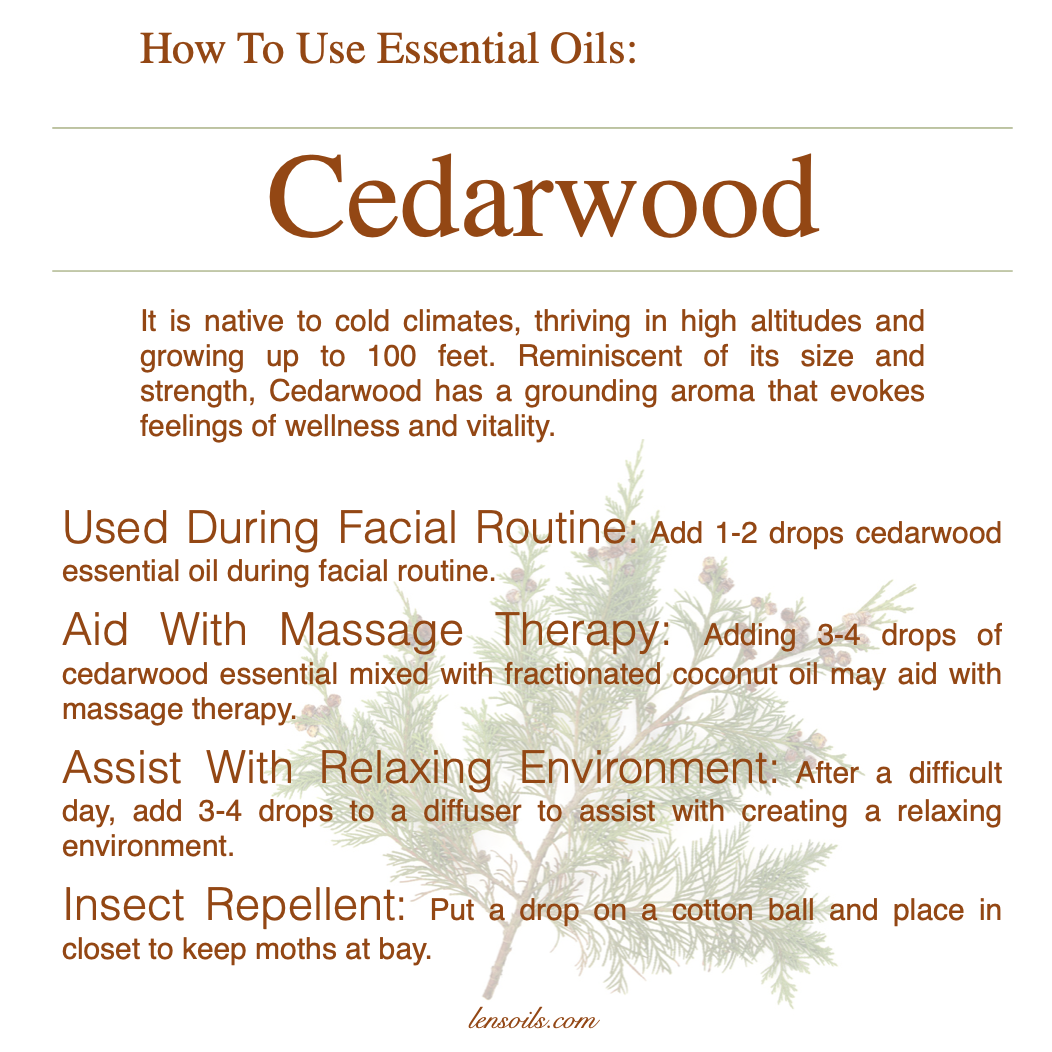
Cedarwood (Cedrus spp.) is a towering evergreen tree native to cold climates, thriving in high altitudes and reaching heights of up to 100 feet. Known for its durability and resilience, cedarwood has been used throughout history in construction, medicine, and spiritual practices. The essential oil, derived from the wood of the tree, carries a rich, grounding aroma that promotes a sense of wellness and vitality. In skincare, adding 1-2 drops of cedarwood essential oil to a facial routine may help promote clear and balanced skin due to its purifying and astringent properties. Additionally, cedarwood is widely used in massage therapy, where 3-4 drops blended with fractionated coconut oilcan provide a calming and muscle-relaxing effect. While historical and anecdotal evidence support these uses, more scientific research is needed to confirm its full range of skin-enhancing and muscle-soothing benefits.

Beyond personal care, cedarwood essential oil is commonly used in aromatherapy to promote relaxation and emotional balance. Adding 3-4 drops to a diffuser can help create a calming environment, particularly after a stressful day. Cedarwood is also known for its insect-repellent properties—placing a drop on a cotton ball and leaving it in a closet may help keep moths at bay. This traditional use is supported by the presence of sesquiterpenes and cedrol, compounds that may have natural insect-deterring effects. However, while cedarwood has been traditionally used as a natural moth repellent, scientific studies on its effectiveness compared to chemical alternatives are still ongoing.

In addition to its well-known uses, cedarwood essential oil has been explored for its potential role in improving sleep quality. Some research suggests that cedrol, a primary component in cedarwood, may have mild sedative effects, which could help support relaxation and restful sleep. Many individuals use cedarwood oil in nighttime diffuser blends or apply a diluted amount to pulse points before bed to encourage a sense of calm. While early findings are promising, more clinical research is needed to confirm its direct impact on sleep disorders or long-term sleep improvement. Regardless, cedarwood essential oil remains a versatile and widely used natural remedy, valued for its aromatic, therapeutic, and protective benefits.

How to Use Essential Oils: Black Pepper

Black pepper essential oil is rich in monoterpenes and sesquiterpenes, powerful compounds known for their antioxidant properties. These compounds help the body combat environmental and seasonal challenges by supporting overall immune function. Beyond its internal benefits, black pepper essential oil is commonly used to promote circulation and soothe sore muscles. Its warming properties make it a popular choice for massage therapy when combined with a carrier oil, helping to relax tense muscles and joints. Historically, black pepper has been valued not only as a prized spice but also for its medicinal benefits in traditional healing practices.

Incorporating black pepper essential oil into a daily routine can offer multiple benefits. Taking 1-2 drops in a veggie cap can provide support during times of seasonal threats, while adding a drop to meals enhances the flavor of meats, soups, and entrées. It is also known for its ability to soothe anxious feelings, as inhaling its warm, spicy aroma can help promote emotional balance. Additionally, black pepper oil can aid digestion when taken internally, helping to stimulate digestive enzymes and improve nutrient absorption. Its ability to support gut health makes it a useful tool for those looking to improve overall digestive function naturally.

Among these uses, black pepper essential oil is also recognized for its potential role in supporting nicotine withdrawal. Research suggests that inhaling black pepper essential oil may help reduce cravings and withdrawal symptoms for those trying to quit smoking. The oil’s stimulating properties can mimic the sensation of inhaling tobacco, which may help curb the urge to smoke. This makes black pepper essential oil a valuable tool not only in cooking and wellness but also in lifestyle changes aimed at promoting better health.

Black Pepper-Did You Know?

Pepper cornsDid you know Black Pepper is the oil of unmasking? It reveals the masks and superficial facades people use to hide aspects of one’s self. Since childhood, most of us have been taught that some feelings and behaviors are acceptable while others are not. So instead of seeking to understand feelings and behaviors that appear to be inappropriate, they usually judge and condemn. People learn early in life in order to be loved, and excepted they must hide their negative behaviors behind a mask or facade. Black Pepper helps people find their authentic self.

Black Pepper also comes in green, red, and white all from the same plant. The color is related to how ripe it is and how it has been processed. Black Pepper is the number one selling spice in America. Pepper is native to India, and grows as a tall vine with the peppercorns as flowering drupes. It has been used in cooking for over 2000 years!

Pepper was mostly eaten by the wealthy in the past, as it was so expensive and sought after. Traders formed spice routes from India to Europe and would often fight over them. In the Middle Ages a man’s wealth was measured by his stock pile of pepper. The Romans would even demand pepper as a ransom when besieging a city.

Black Pepper gets its kick from the compound peperine. Black Pepper loses its flavor and aroma through evaporation, so its best to keep it in an airtight container. Consider using whole peppercorns and grinding just before use to maintain flavor, and add near the end of cooking.

Black Pepper essential oil is high in monoterpenes and sesquiterpenes, known for their antioxidant activity and ability to help ward off environmental and seasonal threats. Black Pepper promotes healthy circulation both internally and externally, but should be used with caution when applied topically due to its strong warming sensation. It may also help curb urges to smoke.

Frankincense-Did You Know?

Frankincense-Did You KnowDid you know Frankincense is the oil of truth? Frankincense helps uncover false truths, and deceptions. It invites people to let go of lower vibrational energy, along with lies, deceptions, and negativity. Frankincense also helps support in creating a healthy attachment with one’s father, and Heavenly Father. It also reminds us we our loved, and protected.

This Arabian tree has been as famous as it has been elusive since long before the birth of Christ, when the three wise men from the East brought it as a gift to that humble stable in Bethlehem. We do not know how far the use of Frankincense goes back in time, but we do know that it scented the Egyptian Temples to honor Ra the ancient solar deity and it is said that Queen Sheba brought a great number of Frankincense trees as a special gift for King Solomon. Unfortunately those trees were destined to die as Frankincense trees only grow in a very limited geographic range and very arid conditions. Nevertheless, it’s the thought that counts and bringing all these trees was indeed a very strong sign of honor and respect. In the ancient world incense trees fueled the economy of the Arab world as oil does today.

Frankincense oil may help with aging, allergies, insect and snake bites, bronchitis, colds, diarrhea, headaches, healing, hemorrhaging, herpes, high blood prerssure, Jaundice and many other health issues. It contains sesquiterpenes, enabling it to go beyond the blood-brain barrier. Frankincense may also help a person have a better attitude, which may help strengthen the immune system.

Black Pepper-Did You Know?

Pepper cornsDid you know Black Pepper is The Oil of Unmasking? It reveals the masks and superficial facades people use to hide aspects of one’s self. Since childhood, most of us have been taught that some feelings and behaviors are acceptable while others are not. So instead of seeking to understand feelings and behaviors that appear to be inappropriate, they usually judge and condemn. People learn early in life in order to be loved, and excepted they must hide their negative behaviors behind a mask or facade. Black Pepper helps people find their authentic self.

Black Pepper also comes in green, red, and white all from the same plant. The color is related to how ripe it is and how it has been processed. Black Pepper is the number one selling spice in America. Pepper is native to India, and grows as a tall vine with the peppercorns as flowering drupes. It has been used in cooking for over 2000 years!

Pepper was mostly eaten by the wealthy in the past, as it was so expensive and sought after. Traders formed spice routes from India to Europe and would often fight over them. In the Middle Ages a man’s wealth was measured by his stock pile of pepper. The Romans would even demand pepper as a ransom when besieging a city.

Black Pepper gets its kick from the compound peperine. Black Pepper loses its flavor and aroma through evaporation, so its best to keep it in an airtight container. Consider using whole peppercorns and grinding just before use to maintain flavor, and add near the end of cooking.

Black Pepper essential oil is high in monoterpenes and sesquiterpenes, known for their antioxidant activity and ability to help ward off environmental and seasonal threats. Black Pepper promotes healthy circulation both internally and externally, but should be used with caution when applied topically due to its strong warming sensation. It may also help curb urges to smoke.

Frankincense-Did You Know?

Frankincense-Did You KnowDid you know Frankincense is the oil of truth? Frankincense helps uncover false truths, and deceptions. It invites people to let go of lower vibrational energy, along with lies, deceptions, and negativity. Frankincense also helps support in creating a healthy attachment with one’s father, and Heavenly Father. It also reminds us we our loved, and protected.

This Arabian tree has been as famous as it has been elusive since long before the birth of Christ, when the three wise men from the East brought it as a gift to that humble stable in Bethlehem. We do not know how far the use of Frankincense goes back in time, but we do know that it scented the Egyptian Temples to honor Ra the ancient solar deity and it is said that Queen Sheba brought a great number of Frankincense trees as a special gift for King Solomon. Unfortunately those trees were destined to die as Frankincense trees only grow in a very limited geographic range and very arid conditions. Nevertheless, it’s the thought that counts and bringing all these trees was indeed a very strong sign of honor and respect. In the ancient world incense trees fueled the economy of the Arab world as oil does today.

Frankincense oil may help with aging, allergies, insect and snake bites, bronchitis, colds, diarrhea, headaches, healing, hemorrhaging, herpes, high blood pressure, Jaundice and many other health issues. It contains sesquiterpenes, enabling it to go beyond the blood-brain barrier. Frankincense may also help a person have a better attitude, which may help strengthen the immune system.

The Blood Brain Barrier

THE BLOOD-BRAIN BARRIER
By David Stewart, Ph.D.,R.A.

It was thought for years that the interstitial tissues of the
brain served as a barrier to keep damaging substances from reaching the neurons of the brain and the cerebrospinal fluid. Instead of a barrier, it would be more accurate to consider it as a sieve or filter through which only molecules of a certain size or smaller can pass.

Most of the molecules of the substances used in chemotherapy are too large to pass through the blood-brain filter, which is why doctors say that chemotherapy doesn’t work on brain cancer. Some of the smaller molecules get through, but not the whole suite of drugs intended.

Doctors don’t know for sure, but it seems that in order to cross the blood-brain barrier, only molecules less than 800-1000 atomic mass units (amu) in molecular weight can get through. Lipid solubility seems to be another factor which facilitates passing through the blood-brain barrier. Water soluble molecules don’t usually penetrate into brain tissue, even when very small. The molecules of essential oils are all not only small, but lipid soluble as well.

In fact, when it comes to essential oils, small molecules (less than 500 amu) are what they are made of. That is why they are aromatic. The only way for something to be aromatic is for the molecules to be so small that they readily leap into the air so they can enter our noses and be detected as odor and smell.

That is why oils for cooking or massage, such as corn, peanut, sesame seed, safflower, walnut, almond, canola, olive and other oils pressed from seeds are not aromatic. Sure, they have a smell, but you can’t smell them across the room in minutes as one can when you opens a bottle of peppermint, hyssop, or cinnamon oil. Essential oils of every species cross the blood-brain barrier.

This makes them uniquely able to address disease, not only from a physical level, but from a more basic and fundamental level-that of the emotions which are often the root cause of physical illness.

A QUICK COURSE IN CHEMISTRY
Because of the tiny molecular structure of the components of an essential oil, they are extremely concentrated. One drop contains approximately 40 million-trillion molecules. Numerically that is a 4 with 19 zeros after it: 40,000,000,000,000,000,000. We have 100 trillion cells in our bodies, and that’s a lot. But one drop of essential oil contains enough molecules to cover every cell in our bodies with 40,000 molecules. Considering that it only takes one molecule of the right kind to open a receptor site and communicate with the DNA to alter cellular function, you can see why even inhaling a small amount of oil vapor can have profound effects on the body, brain, and emotions. Sometimes too many oil molecules overload the receptor sites, and they freeze up without responding at all, when a smaller amount would have been just right. This is why we say that when using oils, “sometimes less is better.”Sometimes more is better, too. Knowing the difference is the art of aromatherapy.

Essential oils are mixtures of dozens, even hundreds, of constituents, all of which are composed of carbon and hydrogen and sometimes oxygen. All essential oils are principally composed of a class of organic compounds built of “isoprene units.”An isoprene unit is a set of five connected carbon atoms with eight hydrogens attached. Their molecular weight is only 68 amu, which is very small, indeed. Molecules built of isoprene units are all classified as “terpenes.” Terpenes are what make essential oils unique in the world of natural substances.

PHENYLPROPANOIDS
Phenylpropanoids are compounds of carbon-ring molecules incorporating one isoprene unit. They are also called hemiterpenes. There are dozens of varieties of phenylpropanoids.

They are found in Clove (90%), Cassia (80%), Basil (75%), Cinnamon (73%), Oregano (60%), Anise (50%), Peppermint (25%). While they can create conditions where unfriendly viruses and bacteria cannot live, the most important function performed by phenylpropanoids is that they clean the receptor sites on the cells. Without clean receptor sites, cells cannot communicate, and the body malfunctions, resulting in sickness.

MONOTERPENES
Monoterpenes are compounds of two isoprene units, which is ten carbon atoms and sixteen hydrogen atoms per molecule- molecular weight 136 amu. There are an estimated 2,000 varieties of monoterpenes.

Monoterpenes are found in most essential oils: Galbanum (80%), Angelica (73%), Hyssop ((70%), Rose of Sharon (54%), Peppermint (45%), Juniper (42%), Frankincense (40%), Spruce (38%), Pine (30%), Cypress (28%), and Myrtle (25%).

While offering a variety of healing properties, the most important ability of the monoterpenes is that they can reprogram miswritten information in the cellular memory. With improper coding in the DNA, cells malfunction and diseases result, including lethal ones such as cancer.

SESQUITERPENES
Sesquiterpenes are compounds of three isoprene units, which is fifteen carbons and twenty-four hydrogens per molecule- molecular weight 204 amu. There are more than 10,000 kinds of sesquiterpenes. Sesquiterpenes are the principal constituents of Cedarwood (98%), Vetiver (97%), Spikenard (93%), Sandalwood (Aloes) 90%, Black Pepper (74%), Patchouli (71%), Myrrh (62%), and Ginger (59%). They are also found in Galbanum, Onycha, and Frankincense (8%).

Sesquiterpene molecules deliver oxygen molecules to cells, like hemoglobin does in the blood. Sesquiterpenes can also erase or deprogram miswritten codes in the DNA. Sesquiterpenes are thought to be especially effective in fighting cancer because the root problem with a cancer cell is that it contains misinformation, and sesquiterpenes can erase that garbled information. At the
same time the oxygen carried by sesquiterpene molecules creates an environment where cancer cells can’t reproduce. Hence, sesquiterpenes deliver cancer cells a double punch-one that disables their coded misbehavior and a second that stops their growth.

The American Medical Association (AMA) has said that if they could find an agent that would pass the blood-brain barrier, they would be able to find cures for ailments such as Lou Gehrig’s disease, multiple sclerosis, Alzheimer’s disease, and Parkinson’s disease. Such agents already exist and have been available since Biblical times. The agents, of course, are essential oils-particularly those containing the brain oxygenating molecules of sesquiterpenes.

THE TRIPLE WHAMMY
The big triple punch combination of “PMS” (Phenylpropanoids, Monoterpenes, and Sesquiterpenes) found in essential oils is very powerful in addressing many illnesses, injuries, and disease conditions. That is because this combination offers the following:

First, you clean the receptor sites allowing the proper transfer of hormones, peptides, neurotransmitters, steroids, and other intracellular messengers. (The Phenylpropanoids do that.)

Second, you deprogram or erase the wrong information from cellular memory stored in the DNA. (The Sesquiterpenes take care of that.)

Third, you reprogram the cells with the correct information so they can function properly. (The Monoterpenes do this.)

These three classes of chemical components are why essential oils can sometimes affect a healing that is nearly instant and also permanent. What they simply do is to restore the body back to its natural state of balance and health. While a specific oil may have one or two of these three classes of compounds as its predominant chemistry, all the Biblical oils contain some of all of them. This is one secret to their amazing healing abilities.

So there you have it in a nutshell: The way the blood-brain barrier works and the biochemistry of one of the ways essential oils can help achieve a healing.