Tag Archives: Essential Oils

Top Essential Oil Leader

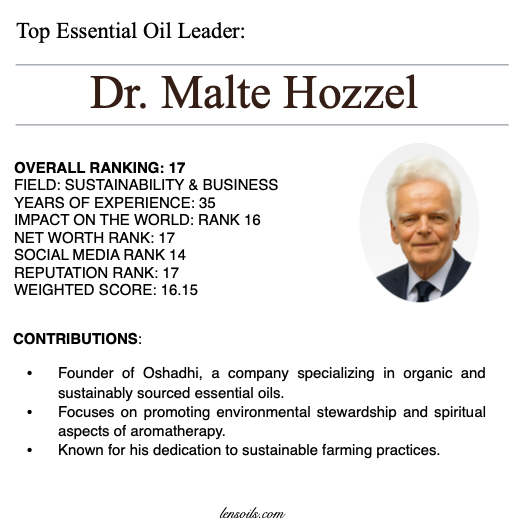
Dr. Malte Hozzel is the founder of Oshadhi, a company established in 1990 that has become internationally recognized for providing high-quality essential oils and aromatherapy products. From its beginnings in Germany, Oshadhi has grown into a respected global brand, distributing oils sourced from around the world. With more than three decades of leadership in the industry, Malte has positioned Oshadhi as a pioneer in combining traditional knowledge with modern understanding of plant-based wellness. His work has helped set standards for purity, authenticity, and responsible sourcing within the essential oil field.

One of Malte’s most significant contributions has been his emphasis on organic and sustainably sourced essential oils. Oshadhi partners with growers who cultivate plants using environmentally friendly and chemical-free practices, ensuring oils are both therapeutic and respectful of the earth. This focus on ecological responsibility reflects Malte’s belief that the health of people and the health of the planet are inseparably linked. Many of Oshadhi’s oils carry organic certification, further supporting his commitment to transparency and quality within the industry.

In addition to his business leadership, Malte has consistently highlighted the holistic dimensions of aromatherapy. He has written, lectured, and taught extensively about how plant essences can support physical health while also contributing to emotional well-being. Through international workshops and educational programs, he has encouraged practitioners and the public to explore aromatherapy as a tool for wellness rooted in both tradition and modern science. This emphasis has made him a recognized educator as well as an entrepreneur.

Malte is also widely respected for advocating sustainable farming practices. By supporting small farmers and distillers worldwide, Oshadhi helps preserve traditional methods of cultivation and distillation that protect biodiversity and cultural heritage. His initiatives have encouraged the development of long-term relationships with suppliers, ensuring that essential oils are produced in ways that maintain ecological balance. This approach has strengthened Oshadhi’s reputation as a company that values both quality and environmental stewardship.

Alongside his entrepreneurial work, Malte has contributed significantly as an author. He has written several books on aromatherapy, including Aromatherapy for Healing the Spirit and other titles that blend practical knowledge with broader reflections on essential oils. His publications are used by practitioners and enthusiasts as reliable resources for understanding both the therapeutic properties and appropriate applications of oils. These works reinforce his role as a leading figure in the field, combining decades of professional experience with clear, research-based writing that continues to educate and guide the aromatherapy community.

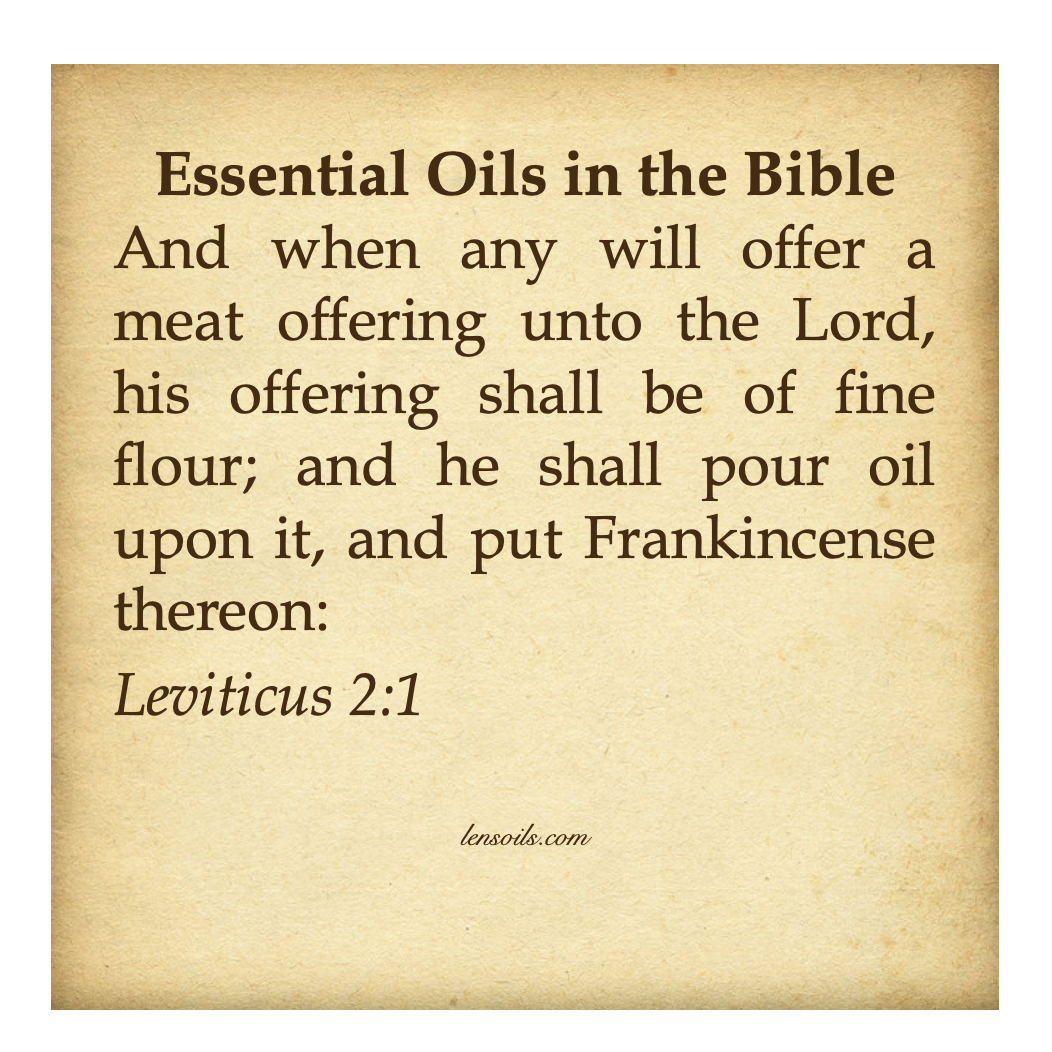
Essential Oils in the Bible

“And when any will offer a meat offering unto the Lord, his offering shall be of fine flour; and he shall pour oil upon it, and put frankincense thereon.”
— Leviticus 2:1

In this passage, frankincense was added to the grain offering, setting it apart as a memorial before God. Its fragrance, when burned, made the simple elements of flour and oil into something sacred, lifted from the ordinary into an act of holy devotion. Unlike animal sacrifices, which were dramatic and costly, the grain offering—with its measure of frankincense—showed that even daily bread could become worship when offered with a pure heart.

Historically, frankincense was a highly sought-after resin, harvested from the Boswellia tree and carried along ancient caravan routes into Israel. It was not just a commodity but a marker of sacred use, always connected with prayer, offerings, and the presence of God. While it served practical purposes in trade and medicine, its role in worship gave it lasting spiritual meaning. Today, frankincense essential oil continues this legacy, supporting prayer and reflection, reminding us of how God transforms the ordinary into the holy.

Top Essential Oil Leader

Valerie Ann Worwood is an internationally recognized authority on aromatherapy and essential oils. She is best known as the author of The Complete Book of Essential Oils and Aromatherapy, first published in 1991, which has become one of the most widely referenced texts in the field. Her work is often described as both practical and comprehensive, making it accessible for beginners while still offering depth for experienced practitioners. Over the years, her books have been translated into multiple languages and have helped spread knowledge of aromatherapy to a worldwide audience.

One of Worwood’s major contributions has been her ability to connect the therapeutic and emotional benefits of essential oils with everyday use. She emphasizes that essential oils are not only for physical well-being but also for supporting mental clarity, emotional balance, and stress relief. This dual focus on body and mind has helped to broaden the understanding of aromatherapy as a holistic practice, reaching beyond traditional applications and into areas of daily living.

In addition to her writing, Valerie Ann Worwood has been a strong advocate for educating the public about safe and effective essential oil use. Her guides frequently provide detailed instructions, blending recipes, and practical tips that allow individuals to incorporate aromatherapy into their homes. Through this approachable style, she has empowered countless readers to explore natural health care while still respecting the importance of proper safety standards in handling concentrated plant extracts.

Beyond her published work, it is believed that Worwood has also been involved in consulting and speaking within the aromatherapy community, sharing her expertise with practitioners and wellness enthusiasts alike. While the extent of these roles may vary over time, her voice has consistently been respected as one that bridges professional knowledge with everyday practicality. Her ability to make essential oils approachable has made her a trusted figure among both casual users and those working professionally in the field.

Today, Valerie Ann Worwood continues to be celebrated as one of the most influential authors in aromatherapy. Her decades of involvement, stretching back to at least the late 1980s, have left a lasting mark on the way essential oils are understood and used across the globe. While she may not always be in the public spotlight, her writings remain a cornerstone of modern aromatherapy education, ensuring her influence will endure for years to come.

How to Use Essential Oils: Elemi

Elemi essential oil, steam-distilled from the resin of the Canarium luzonicum tree, has a bright, lemony, and slightly peppery aroma with hints of pine. Native to the Philippines, elemi has been valued for centuries as both a spiritual and medicinal resin, often compared to frankincense and myrrh because they come from the same botanical family. In essential oil form, its uplifting scent is known to refresh the mind, promote focus, and create a feeling of lightness. Diffused, it brings a clean, balancing energy that supports both clarity and calm.

Beyond its uplifting qualities, elemi essential oil is often used in skin care and wellness blends. Its resinous compounds make it helpful for supporting healthy-looking skin, and it is sometimes added to facial oils or serums for a rejuvenating effect. In aromatherapy, it blends well with citrus oils like bergamot or grounding oils like frankincense, making it a versatile choice for meditation, relaxation, and emotional balance. Its crisp, citrus-pine aroma also makes it useful in natural cleaning sprays or room fresheners.

Did You Know? The word “elemi” is thought to come from an Arabic phrase meaning “above and below,” reflecting its traditional use for balancing both spirit and body. Like frankincense and myrrh, elemi belongs to the Burseraceae family, and during the 17th and 18th centuries it was sometimes used in church incense as a substitute when frankincense was scarce. Its lemony-pine fragrance added a fresh note to Christmas and festival celebrations, giving elemi a subtle but meaningful connection to the season.

Bark of Bravery

Cassia is oil of self-assurance,
Its scarlet bark warms the soul.
It stirs gladness, courage, and cheer,
Helping the timid become whole.

It comforts the heart when it falters,
Whispers, “Stand tall, do not hide.”
Through laughter it brightens the spirit,
Releasing the fears kept inside.

No longer embarrassed or shrinking,
Nor haunted by judgment’s sting.
The shy and insecure are lifted,
Their voices are taught to sing.

When feeling humiliated, worthless,
Or weighed by shadows of doubt,
Cassia lights flames of boldness,
And turns hesitation about.

Its fragrance calls forth new horizons,
A path where the brave dare to tread.
Cassia inspires the journey of living,
Awakening hope where fear once spread.

With courage restored to the spirit,
And gladness set joyfully free,
We stand in the strength of cassia—
Wrapped in its gift, the true Bark of Bravery.

Top Essential Oil Leader

Salvatore Battaglia is an Australian aromatherapist and author, best known for writing The Complete Guide to Aromatherapy. First published in 1995, the book has since gone through several editions and is widely used in professional training and education. It contains detailed essential oil profiles, therapeutic applications, historical background, and safety guidelines that remain standard references for students and practitioners.

He is the founder of Perfect Potion, an Australian company established in the early 1990s. The business produces essential oils, natural skincare, and aromatherapy products for retail and professional use. Perfect Potion has become recognized for emphasizing holistic health, sustainable production, and environmentally responsible practices that align with Battaglia’s interest in natural wellness.

Battaglia has been a consistent advocate for sustainable and ethical sourcing of essential oils within the international industry. His work through Perfect Potion, along with his writing and speaking, has drawn attention to the importance of fair trade, transparency in supply chains, and ecologically conscious methods of harvesting. These priorities are reflected in the company’s partnerships and policies.

In addition to his role as an entrepreneur, Battaglia has remained active as a lecturer and educator in aromatherapy. He has spoken at conferences, workshops, and professional training gatherings both in Australia and overseas. His lectures often combine practical therapeutic information with references to available research, providing reliable resources for students, practitioners, and interested members of the community.

His career demonstrates a combination of authorship, entrepreneurship, and education in aromatherapy. Through his books, company, and teaching activities, Battaglia has contributed to awareness of professional standards and ethical approaches to the use of essential oils. While others have also advanced the field, his steady involvement for more than three decades has established him as a recognized figure in modern aromatherapy.

Forest of Strength and The Rest of the Story

It began high in the misty mountains, where towering evergreens pierced the clouds and the air always seemed a little lighter. These trees stood like guardians of the land, their scent riding the breeze long before footsteps touched the trail. Long ago, Indigenous communities in the Pacific Northwest made good use of them. The twigs were added to steam baths. The sap was applied with care. The needles were brewed into tea. And though no one wrote it down at the time, the knowledge passed from hand to hand, heart to heart. They didn’t need proof. They just knew.

Early settlers learned from what they saw and felt. After chopping wood or hunting game, they noticed how the forest seemed to restore something in them. A fresh bundle of needles in the cabin could clear the air. The resin, rubbed into sore muscles, seemed to ease tension. In winter, a hot drink steeped from green needles wasn’t just comforting—it felt necessary. People came to trust the tree, even before they knew its name.

Only in more recent times did anyone stop to measure what had always been felt. Scientists began taking a closer look at what made the scent so uplifting and the forest air feel so restorative. They found natural compounds in the oil that gave it a crisp, clean, slightly citrusy aroma. The same compounds showed promise in lab tests for keeping surfaces clean and lifting the mood during a foggy afternoon. But most people didn’t need the data. They’d already been using it for years.

In forested valleys, the practice continues. Harvesters still clip needles and twigs by hand, often in the early morning when the trees are still damp with mountain dew. Timing matters. So does care. A slight change in season or elevation can alter the character of the oil. That’s why those who value it most partner directly with growers who understand the land. One such company, doTERRA, has made it their mission to work with forest stewards—preserving the integrity of the process, supporting communities, and protecting the wild stands that have given so generously.

The tall tree with soft green needles and a bright, woodsy scent has long helped people breathe easier, feel more grounded, and reconnect with the calm of the forest. And that name? It didn’t come from the people who lived under its shade for centuries. It came later, in 1825, when a young Scottish botanist named David Douglas traveled across North America on behalf of the Royal Horticultural Society. Among many plants he documented, this towering conifer stood out—and so the tree was named in his honor. This tree is Douglas Fir. Now you know the rest of the story

How To Use Essential Oils: Davana

Davana essential oil, distilled from the leaves and flowers of the Artemisia pallens plant, is treasured for its rich, fruity, and slightly woody aroma. Native to southern India, it has been used for centuries in traditional practices, especially in Ayurveda and spiritual ceremonies. Its exotic fragrance makes it a rare and prized addition to perfumery, where it is valued for its ability to bring warmth, depth, and a unique sweetness to blends. Diffused, it creates a calming, uplifting environment that feels both luxurious and comforting.

Beyond its aromatic appeal, davana essential oil is often turned to for supporting emotional balance and easing daily tension. It blends well with bright citrus oils such as orange or bergamot for cheerful diffuser recipes and pairs beautifully with grounding oils like sandalwood or patchouli for meditation or relaxation. Its sweet, almost apricot-like scent makes it a favorite in natural perfumes, lotions, and personal care blends where a touch of richness is desired.

Did You Know? In India, davana flowers are traditionally offered to Lord Shiva as a sign of devotion and purity. One of its most fascinating qualities is that the oil’s aroma changes slightly depending on each person’s chemistry, making it smell different on different individuals. This rare trait has made davana one of the most sought-after oils in luxury perfumery, prized for its ability to create a scent that feels uniquely personal.