
Ingredients
2 Tablespoons coconut oil
2 Tablespoons shea butter
1 Tablespoon jojoba oil
1 tbsp. beeswax granules
1 tbsp. zinc oxide powder (optional)
½ tsp. red raspberry seed oil
½ tsp. carrot seed oil
Add one drop of each essential oil of your choice. Geranium, lavender, rosemary, and or peppermint all work well.
Instructions
1. Using a double boiler (or a small pan over very low heat), melt your coconut oil, sesame or jojoba oil, beeswax, and shea butter together. The beeswax will be the last to melt.
2. When the beeswax is melted, remove the mixture from the heat and let cool to room temperature. If you’re using zinc oxide, whisk it in at this point, being careful not to create a lot of dust. If there are some lumps, that’s OK. They will break up when you whip the body butter in step 4.
3. Move the mixture to the fridge for 15-30 minutes. You want it to start to set up, but still be soft enough to whip.
4. Take the mixture out of the fridge and using a stand mixer or hand mixer, start to whip it. Slowly add in the red raspberry seed oil, the carrot seed oil, and any essential oils of your choice, and continue whipping until the mixture is light and fluffy.
5. Use as you would any regular sunscreen. Application rates will depend on your activity and exposure to water. Store in a glass container in the fridge between uses.
Tag Archives: Peppermint
Essential Oils Studied for Antibacterial Properties
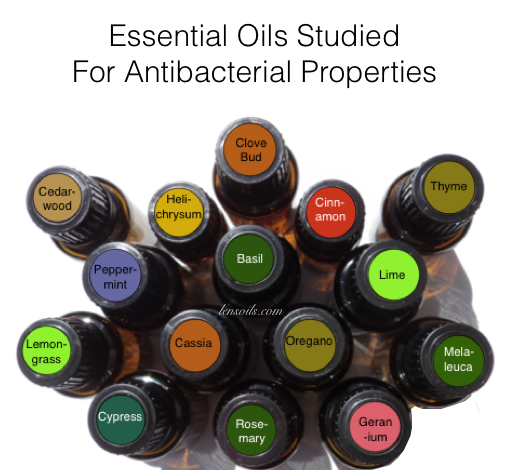
The term antibacterial refers to anything that kills bacteria or limits its ability to grow or reproduce.
Basil Essential Oil
Basil is cooling to the skin, and can be used to soothe minor irritations. When diffused, Basil helps promote clear breathing, and healthy respiratory function while sharpening focus, and lessening stress.
Learn More
Cassia Essential Oil
When diluted, Cassia can help soothe sore, achy joints. Cassia can be used in cooking either as a replacement for Cinnamon in pies and breads, or by itself in many different entrees and desserts.
Learn More
Cedarwood Essential Oils
Cedarwood will help maintain healthy breathing and respiratory function and, when applied topically, Cedarwood promotes clear, healthy skin. This oil is also used in massage therapy to relax the mind and body.
Learn More
Cinnamon Essential Oil
Cinnamon is strong, so be sure to dilute it (3 drops of carrier oil to 1 drop of cinnamon), but you can cook, bake, or even make candy with it too.
Learn More
Clove Essential Oil
Clove has been used for years in dental preparations,candy, and gum for its flavor and ability to promote oral health, yet it provides a myriad of health benefits.
Learn More
Cypress Essential Oil
Cypress assists with clear breathing, and promotes healthy respiratory function. It also soothes tight muscles and supports localized blood flow. This oil is helpful for oily skin conditions.
Learn More
Geranium Essential Oil
This oil has been used to promote clear skin and healthy hair, making it ideal for skin and hair care products. It also helps calm nerves and lessen stress.
Learn More
Helichrysum Essential Oil
Helichrysum is great for regenerative effects, can be used without dilution for most people. No first aide kit should be without this oil.
Learn More
Lemongrass Essential Oil
This oil supports healthy digestion, and soothes aching muscles. Lemongrass purifies and tones skin, and acts as an overall tonic to the body’s systems.
Learn More
Lime Essential Oil
Lime oil can usually be used without diluting, depending on skin sensitivity, and can be taken internally, but like all citrus oils, it can cause sensitivity to the sun with topical use up to 12 hours prior, so using it before bed is a great option.
Learn More
Melaleuca Essential Oil
Melaleuca is best known for its purifying properties. It can be used to cleanse and purify. Taken internally, Melaleuca enhances immunity when seasonal threats are high.
Learn More
Oregano Essential Oil
Oregano is one of the most potent essential oils. It must be diluted (3 drops of carrier oil to 1 drop of Oregano essential oil when used topically). Apply to reflex points. It can be used as a flavoring in cooking.
Learn More
Peppermint Essential Oil
Peppermint is very pleasing to the taste buds (you can add the oil to tea or water), but is powerfully soothing to the digestive system. You can usually apply it without diluting, inhale for nausea, or take internally as suggested.
Learn More
Rosemary Essential Oil
Rosemary supports healthy digestion and helps soothe sore muscles and joints. This oil also helps reduce nervous tension and fatigue.
Learn More
Thyme Essential Oil
Thyme makes a great defense against many concerns, although it should always be diluted (4 drops carrier oil to 1 drop thyme). You can also cook with it. This oil has cleansing and purifying effects for the skin.
Learn More
Peppermint-Did You Know?
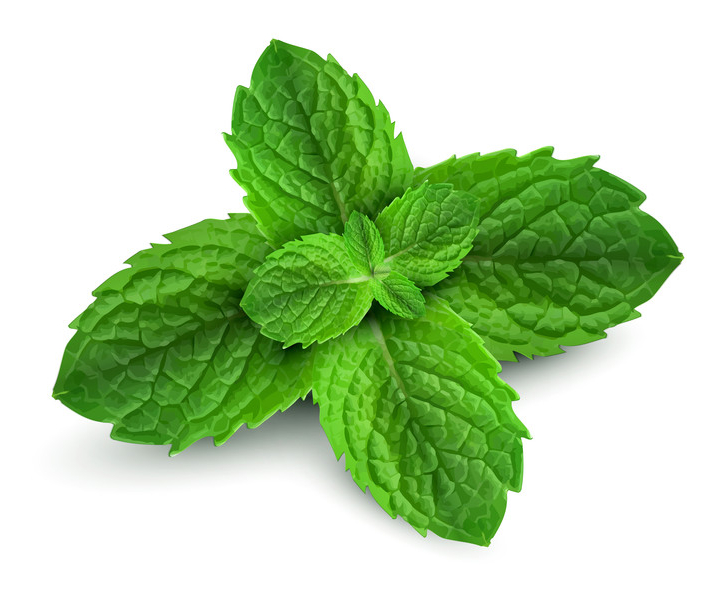 Did you know Peppermint is the oil of a buoyant heart? Peppermint brings happiness, and optimism to the heart and soul. It gives strength to the body, mind and spirit, and reminds us that life can be filled with happiness, and there is nothing to fear. When a person uses Peppermint they feel as though they are moving smoothly through life.
Peppermint (Mentha piperita) is one of hundreds of species in the genus Mentha which also includes spearmint, water mint and forest mint originating in North America and the Mediterranean area of Europe. Peppermint is actually believed to be a naturally occurring hybrid of spearmint and water mint. While some claim peppermint was not hybridized and cultivated until the 18th century in England, peppermint is referenced in ancient texts.
Peppermint oil can also calm the spasms that cause muscle cramps? Menthol which is in peppermint provides effective relief from many respiratory problems including nasal congestion, sinusitis, asthma, bronchitis and the common cold and cough. It is often included as an ingredient in natural chest rubs to help with congestion.
Peppermint is Powerful

One of my favorite things to do is watch someone experience Peppermint essential oil for the first time. When I am sharing essential oils with a group of people, I will put one drop of oil in the palm of their hand. Then have them put their hands together and rub. Then I have them put their hands in a cupping shape and breathe in the pure scent of pure peppermint essential oil. It is funny to see their reaction not hardly believing that one drop of this oil can be so powerful.
I have no doubt God put plants on earth for our use. Peppermint definitely makes its presence known. I enjoy the powerful effects of this oil, using peppermint on a regular basis year round. In Winter I use it to help keep me clear of congestion. In Spring it helps with allergies. In Summer it helps keep me cool. In the Fall I use peppermint in cooking, and for allergies.
I am amazed how many people run to their medicine cabinet when they have any kind of ailment. My grandpa Richie became a pharmacist after my uncle died at age seven, from a accidental drug overdose, being given an adult sized dose when he was sick. My grandpa always said drugs are to sell not to use. He was aware of all the negative side effects every medication has.
When I get a headache I like to rub peppermint right on the location of my headache, or PastTense an essential oil blend, made specifically for headaches that has peppermint essential oil in it. Nature’s medicine cabinet is very powerful with no side effects. Due to my childhood up bringing, I have always had the mantra of less is more. If on a very rare occasion I do use prescription drugs, they are more effective because I use them less often, and my body has not built up a resistance to them. My first line of defense is essential oils.
The Blood Brain Barrier
THE BLOOD-BRAIN BARRIER
By David Stewart, Ph.D.,R.A.
It was thought for years that the interstitial tissues of the
brain served as a barrier to keep damaging substances from reaching the neurons of the brain and the cerebrospinal fluid. Instead of a barrier, it would be more accurate to consider it as a sieve or filter through which only molecules of a certain size or smaller can pass.
Most of the molecules of the substances used in chemotherapy are too large to pass through the blood-brain filter, which is why doctors say that chemotherapy doesn’t work on brain cancer. Some of the smaller molecules get through, but not the whole suite of drugs intended.
Doctors don’t know for sure, but it seems that in order to cross the blood-brain barrier, only molecules less than 800-1000 atomic mass units (amu) in molecular weight can get through. Lipid solubility seems to be another factor which facilitates passing through the blood-brain barrier. Water soluble molecules don’t usually penetrate into brain tissue, even when very small. The molecules of essential oils are all not only small, but lipid soluble as well.
In fact, when it comes to essential oils, small molecules (less than 500 amu) are what they are made of. That is why they are aromatic. The only way for something to be aromatic is for the molecules to be so small that they readily leap into the air so they can enter our noses and be detected as odor and smell.
That is why oils for cooking or massage, such as corn, peanut, sesame seed, safflower, walnut, almond, canola, olive and other oils pressed from seeds are not aromatic. Sure, they have a smell, but you can’t smell them across the room in minutes as one can when you opens a bottle of peppermint, hyssop, or cinnamon oil. Essential oils of every species cross the blood-brain barrier.
This makes them uniquely able to address disease, not only from a physical level, but from a more basic and fundamental level-that of the emotions which are often the root cause of physical illness.
A QUICK COURSE IN CHEMISTRY
Because of the tiny molecular structure of the components of an essential oil, they are extremely concentrated. One drop contains approximately 40 million-trillion molecules. Numerically that is a 4 with 19 zeros after it: 40,000,000,000,000,000,000. We have 100 trillion cells in our bodies, and that’s a lot. But one drop of essential oil contains enough molecules to cover every cell in our bodies with 40,000 molecules. Considering that it only takes one molecule of the right kind to open a receptor site and communicate with the DNA to alter cellular function, you can see why even inhaling a small amount of oil vapor can have profound effects on the body, brain, and emotions. Sometimes too many oil molecules overload the receptor sites, and they freeze up without responding at all, when a smaller amount would have been just right. This is why we say that when using oils, “sometimes less is better.”Sometimes more is better, too. Knowing the difference is the art of aromatherapy.
Essential oils are mixtures of dozens, even hundreds, of constituents, all of which are composed of carbon and hydrogen and sometimes oxygen. All essential oils are principally composed of a class of organic compounds built of “isoprene units.”An isoprene unit is a set of five connected carbon atoms with eight hydrogens attached. Their molecular weight is only 68 amu, which is very small, indeed. Molecules built of isoprene units are all classified as “terpenes.” Terpenes are what make essential oils unique in the world of natural substances.
PHENYLPROPANOIDS
Phenylpropanoids are compounds of carbon-ring molecules incorporating one isoprene unit. They are also called hemiterpenes. There are dozens of varieties of phenylpropanoids.
They are found in Clove (90%), Cassia (80%), Basil (75%), Cinnamon (73%), Oregano (60%), Anise (50%), Peppermint (25%). While they can create conditions where unfriendly viruses and bacteria cannot live, the most important function performed by phenylpropanoids is that they clean the receptor sites on the cells. Without clean receptor sites, cells cannot communicate, and the body malfunctions, resulting in sickness.
MONOTERPENES
Monoterpenes are compounds of two isoprene units, which is ten carbon atoms and sixteen hydrogen atoms per molecule- molecular weight 136 amu. There are an estimated 2,000 varieties of monoterpenes.
Monoterpenes are found in most essential oils: Galbanum (80%), Angelica (73%), Hyssop ((70%), Rose of Sharon (54%), Peppermint (45%), Juniper (42%), Frankincense (40%), Spruce (38%), Pine (30%), Cypress (28%), and Myrtle (25%).
While offering a variety of healing properties, the most important ability of the monoterpenes is that they can reprogram miswritten information in the cellular memory. With improper coding in the DNA, cells malfunction and diseases result, including lethal ones such as cancer.
SESQUITERPENES
Sesquiterpenes are compounds of three isoprene units, which is fifteen carbons and twenty-four hydrogens per molecule- molecular weight 204 amu. There are more than 10,000 kinds of sesquiterpenes. Sesquiterpenes are the principal constituents of Cedarwood (98%), Vetiver (97%), Spikenard (93%), Sandalwood (Aloes) 90%, Black Pepper (74%), Patchouli (71%), Myrrh (62%), and Ginger (59%). They are also found in Galbanum, Onycha, and Frankincense (8%).
Sesquiterpene molecules deliver oxygen molecules to cells, like hemoglobin does in the blood. Sesquiterpenes can also erase or deprogram miswritten codes in the DNA. Sesquiterpenes are thought to be especially effective in fighting cancer because the root problem with a cancer cell is that it contains misinformation, and sesquiterpenes can erase that garbled information. At the
same time the oxygen carried by sesquiterpene molecules creates an environment where cancer cells can’t reproduce. Hence, sesquiterpenes deliver cancer cells a double punch-one that disables their coded misbehavior and a second that stops their growth.
The American Medical Association (AMA) has said that if they could find an agent that would pass the blood-brain barrier, they would be able to find cures for ailments such as Lou Gehrig’s disease, multiple sclerosis, Alzheimer’s disease, and Parkinson’s disease. Such agents already exist and have been available since Biblical times. The agents, of course, are essential oils-particularly those containing the brain oxygenating molecules of sesquiterpenes.
THE TRIPLE WHAMMY
The big triple punch combination of “PMS” (Phenylpropanoids, Monoterpenes, and Sesquiterpenes) found in essential oils is very powerful in addressing many illnesses, injuries, and disease conditions. That is because this combination offers the following:
First, you clean the receptor sites allowing the proper transfer of hormones, peptides, neurotransmitters, steroids, and other intracellular messengers. (The Phenylpropanoids do that.)
Second, you deprogram or erase the wrong information from cellular memory stored in the DNA. (The Sesquiterpenes take care of that.)
Third, you reprogram the cells with the correct information so they can function properly. (The Monoterpenes do this.)
These three classes of chemical components are why essential oils can sometimes affect a healing that is nearly instant and also permanent. What they simply do is to restore the body back to its natural state of balance and health. While a specific oil may have one or two of these three classes of compounds as its predominant chemistry, all the Biblical oils contain some of all of them. This is one secret to their amazing healing abilities.
So there you have it in a nutshell: The way the blood-brain barrier works and the biochemistry of one of the ways essential oils can help achieve a healing.
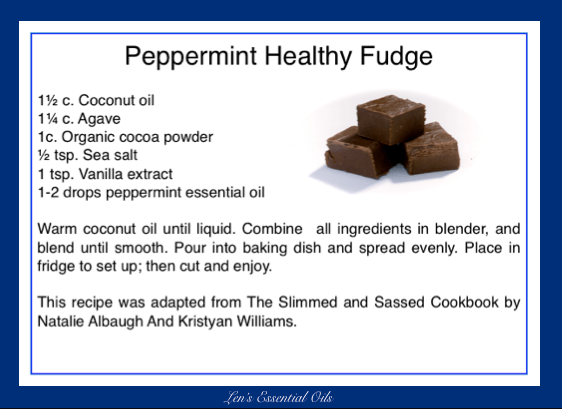
Peppermint Healthy Fudge
 Len's Oils