Isaiah 61:3 speaks to restoration after loss, using everyday elements people understood deeply. Ashes were a sign of grief and mourning, while oil was associated with care, comfort, and renewal. In Book of Isaiah, the “oil of joy” contrasts directly with mourning, pointing to a deliberate act of replacing sorrow with something that restores the body and lifts the spirit. Oil was not abstract or symbolic alone — it was applied, felt, and experienced as part of healing and celebration.
Essential oils fit naturally into this promise. Fragrant oils were used to soothe the weary, honor the brokenhearted, and mark moments of change from sorrow to hope. To receive oil instead of ashes meant moving from despair into dignity, from heaviness into praise. The verse shows how physical care and spiritual renewal were intertwined, much like trees planted and tended over time, growing strong and steady as living evidence of restoration and joy.
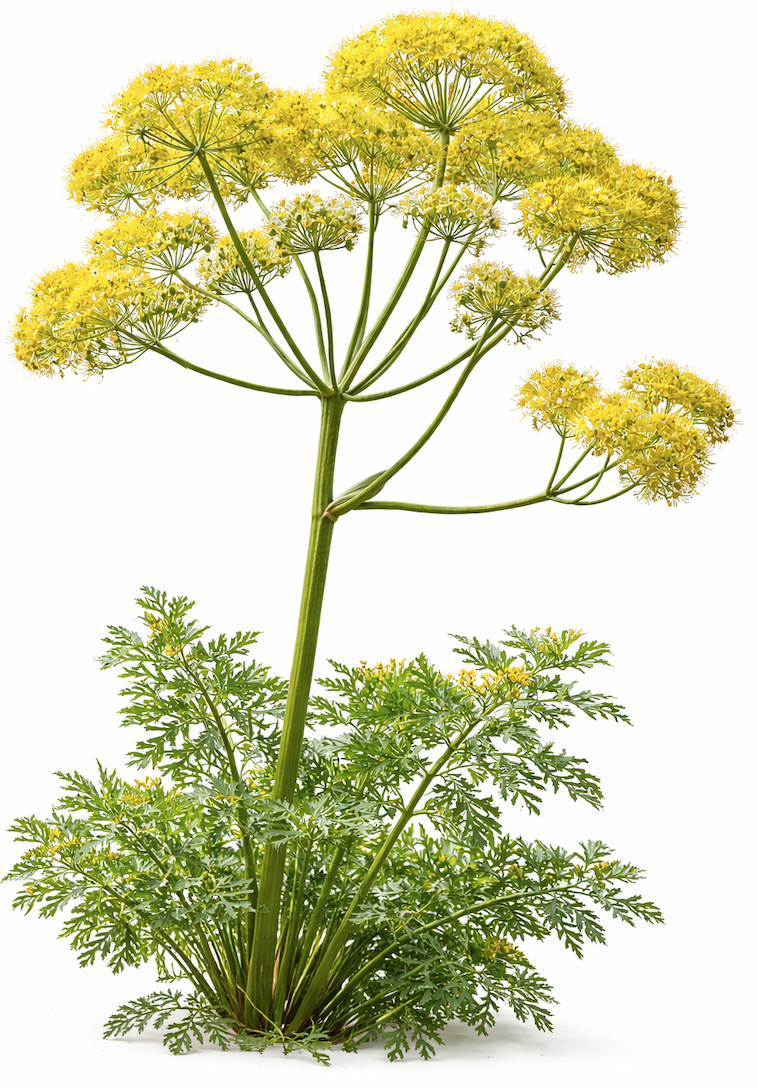
Long before people wrote recipes, laws, or letters home, they learned which plants truly mattered.Some soothed pain, some healed wounds, and some demanded immediate respect the moment they were cut.In dry lands where wind and stone shaped daily survival, a tall wild plant guarded an unusual secret.When its thick stalk was scored, a pale milky sap slowly appeared and clung stubbornly.It hardened into something unforgettable, sharp enough to stop travelers and traders alike.
Ancient traders learned quickly that not all scents were meant to charm or invite comfort. This one did not whisper politely but announced itself boldly and without apology. Strong aromas were believed to travel farther than spoken words, reaching gods, spirits, and sickness alike. People burned such substances to cleanse air, protect spaces, and steady unseen forces. Powerful smells, they believed, signaled powerful results waiting to happen.
Physicians of the ancient world paid careful attention to this persistent resin. They recorded how certain substances warmed the body and stirred systems thought to be sluggish. Greek thinkers observed its effects on breath, circulation, and physical movement within the body. They trusted plants that survived harsh terrain to perform serious internal work. Gentle cures were appreciated, but strong ones were carefully remembered and reused.
As knowledge moved westward across empires, so did this resin. Merchants carried it along dusty trade routes linking Persia with the Mediterranean world. Roman apothecaries stocked it beside oils meant for medicine, ceremony, and disciplined ritual use. It was burned in temples and mixed into salves with practical intent. This was not a scent for leisure, but for clear purpose and deliberate use.
Religious tradition eventually gave the resin a role few substances ever earn. In sacred incense formulas, it stood beside sweeter companions by deliberate design. Its presence was not optional but required for completeness. Later teachers explained it symbolized harsher parts of humanity that still belonged. Without it, the offering was considered unfinished and lacking balance within the whole.
Centuries passed, and scholars in desert libraries quietly kept the knowledge alive. Arabic and Persian physicians translated ancient texts and tested older remedies again. They used strong resins for breath, inflammation, nervous tension, and mental clarity. Trade routes ensured the substance never vanished entirely from use. Quietly, it endured while fashions and preferences rose and fell.
During the Renaissance, Europe rediscovered classical learning and old remedies together. Herbalists once again cataloged resins with careful observation and respect. They noted this one’s bitter green character and deeply grounding nature. Perfumers learned a single drop could anchor an entire fragrance structure. Too much overwhelmed the senses, while too little left something missing.
The modern era gave the resin an unexpected new stage. Twentieth-century perfumers reached for it when sweetness began to feel dishonest. They wanted clarity, sharp edges, and something unmistakably alive. This scent brought discipline and structure back into fragrance creation. It reminded the nose that beauty does not require softness to endure.
Even today, the process behind this resin has barely changed. The plant is cut, the sap collected, and the essence carefully drawn out. It appears in diffusers, massage oils, perfumes, and even household cleaners. A few drops can freshen air, ground emotions, or steady a moment. Old habits continue, simply adapted to modern bottles and everyday use.
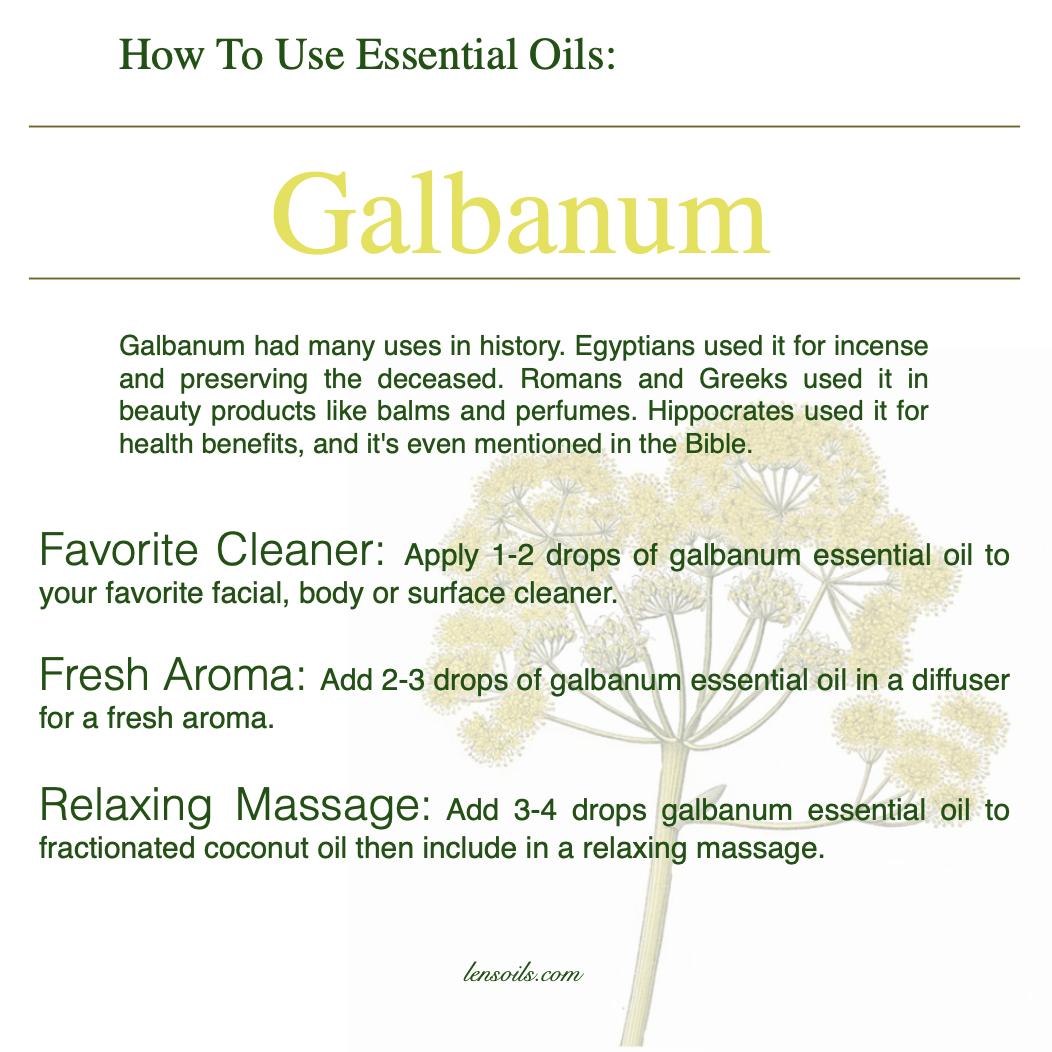
The resin that puzzled priests, physicians, and perfumers alike is called galbanum. Used by Egyptians, Greeks, Romans, and writers of scripture, it never tried to be liked. It simply did its work faithfully, century after century, without softening its nature. Strong, honest, and unforgettable in every era it touched. And now you know the rest of the story.
Matthew 6:28–29 appears within a teaching where Jesus addresses ordinary people living with daily uncertainty. His audience included laborers, farmers, and families who worried about food, clothing, and survival. Clothing was costly, time-consuming to produce, and closely tied to security and dignity. When Jesus spoke about raiment, He was speaking directly to real anxieties, not abstract spiritual concerns.
To make His point, Jesus turned attention away from human effort and toward the natural world. The hillsides were filled with wildflowers that bloomed freely, without cultivation or labor. By contrasting these flowers with the grandeur of Solomon, He highlighted the difference between beauty produced through striving and beauty that simply exists by design. The message was not about rejecting responsibility, but about re-examining where trust and value truly come from.
Jesus draws attention to the lilies of the field—real, aromatic plants that people in Galilee saw, smelled, and touched every day. In the ancient world, flowers and herbs were not just visual decorations; they were closely tied to fragrance, medicine, and daily life. Many plants released natural aromas when crushed or warmed by the sun. By inviting people to consider the lilies, He was pointing to how God-designed plants grow, flourish, and express beauty without anxiety, manufacture, or force.
For this reason, the passage is often viewed as an essential-oil verse in principle. It reflects the idea that plants were created with inherent purpose, carrying beauty and function within them. Essential oils mirror this concept by concentrating what already exists in the plant rather than adding something artificial. The teaching ultimately invites trust, reminding readers that provision, care, and even restoration often come through receiving what has already been given to us in life.
In Matthew 23, Jesus is speaking publicly in Jerusalem during the final week before His arrest. He is addressing the crowds and His disciples, but His words are aimed directly at the religious leaders of the time—the scribes and Pharisees. These men were highly respected for their knowledge of the Law of Moses and for their strict outward obedience. They were known for carefully following detailed religious rules, especially those that could be seen and measured, such as fasting, public prayer, and tithing even the smallest household herbs.
The specific mention of mint, anise, and cumin reflects how far this attention to detail had gone. These were common garden spices, inexpensive and small, yet the Pharisees meticulously counted and tithed them to demonstrate obedience. While this practice was not wrong in itself, Jesus pointed out that their focus on minor regulations had come at the expense of far more important responsibilities—justice toward others, mercy for those in need, and faithfulness of heart. In other words, they were keeping the letter of the law while neglecting its spirit.
Jesus’ rebuke was not a rejection of discipline or obedience, but a call for balance and integrity. He acknowledged that careful practices had their place, but insisted they should never replace compassion, fairness, and genuine devotion. Matthew 23:23 exposes a deeper problem: religious performance without transformed character. It serves as a warning that devotion measured only by outward acts can miss the very heart of what God desires.
Galbanum essential oil, steam-distilled from the resin of the Ferula galbaniflua plant, has a strong, green, and earthy aroma with hints of spice and balsam. Native to the Middle East and western Asia, galbanum has been used since ancient times in incense, perfumes, and healing balms. Its unique fragrance is both grounding and stimulating, making it a distinctive choice for meditation, reflection, and spiritual practice. Diffused, galbanum creates a deep, resinous atmosphere that connects the mind and spirit.
Beyond its ancient spiritual heritage, galbanum essential oil is valued in modern aromatherapy for its calming and restorative qualities. It blends well with wood oils like cedarwood, floral oils like lavender, and other resins such as frankincense and myrrh. In perfumery, galbanum is often used as a fresh top note that adds depth, richness, and brightness to blends. In wellness practices, it is sometimes included in diluted massage oils for soothing and balancing the body.
Did You Know? Galbanum is mentioned in the Bible as one of the sacred ingredients in the holy incense described in Exodus 30:34, alongside frankincense and myrrh. Ancient Egyptians also used galbanum resin in embalming practices and temple offerings, while Roman and Greek physicians recommended it for various remedies. Today, its distinctive balsamic aroma is still prized in high-end perfumery and spiritual blends, keeping its place as one of history’s most treasured resins.
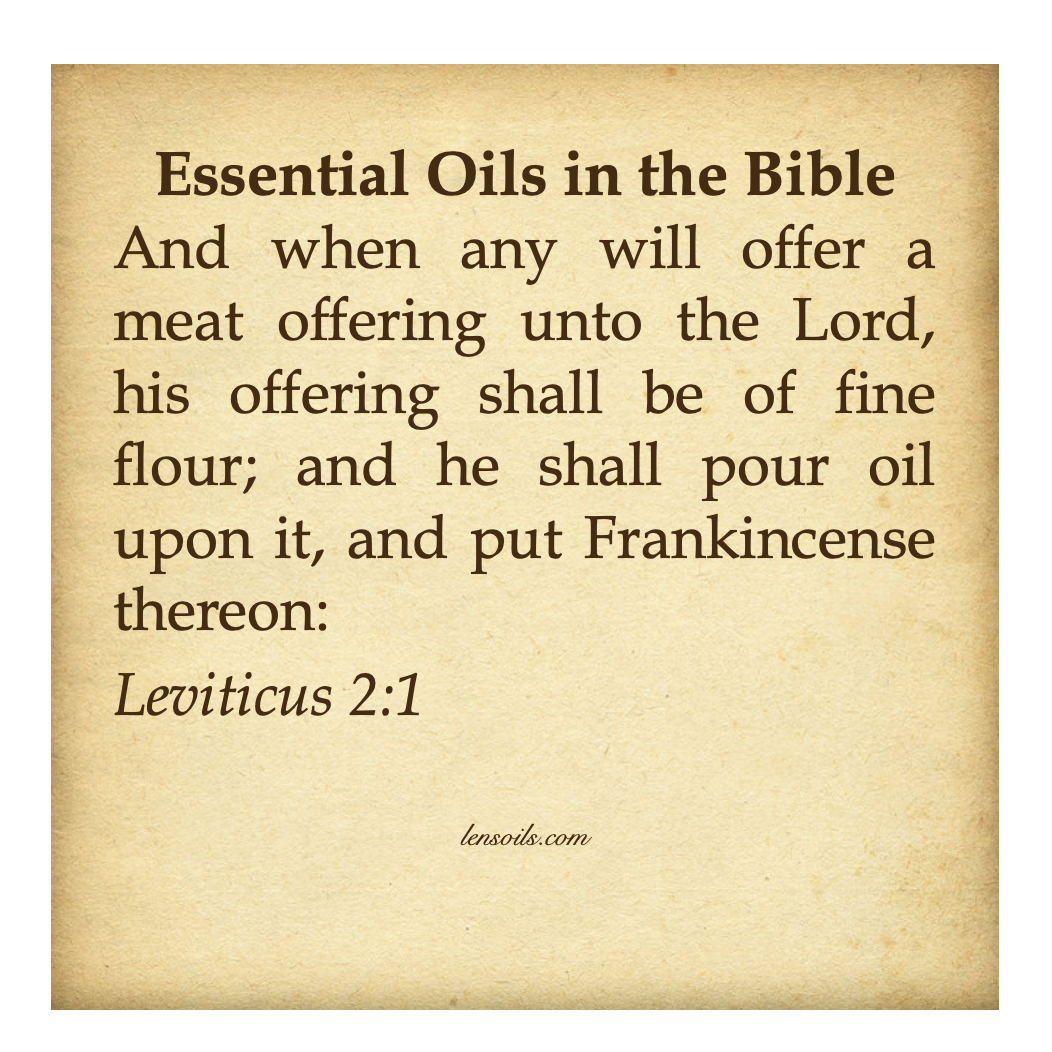
“And when any will offer a meat offering unto the Lord, his offering shall be of fine flour; and he shall pour oil upon it, and put frankincense thereon.” — Leviticus 2:1
In this passage, frankincense was added to the grain offering, setting it apart as a memorial before God. Its fragrance, when burned, made the simple elements of flour and oil into something sacred, lifted from the ordinary into an act of holy devotion. Unlike animal sacrifices, which were dramatic and costly, the grain offering—with its measure of frankincense—showed that even daily bread could become worship when offered with a pure heart.
Historically, frankincense was a highly sought-after resin, harvested from the Boswellia tree and carried along ancient caravan routes into Israel. It was not just a commodity but a marker of sacred use, always connected with prayer, offerings, and the presence of God. While it served practical purposes in trade and medicine, its role in worship gave it lasting spiritual meaning. Today, frankincense essential oil continues this legacy, supporting prayer and reflection, reminding us of how God transforms the ordinary into the holy.
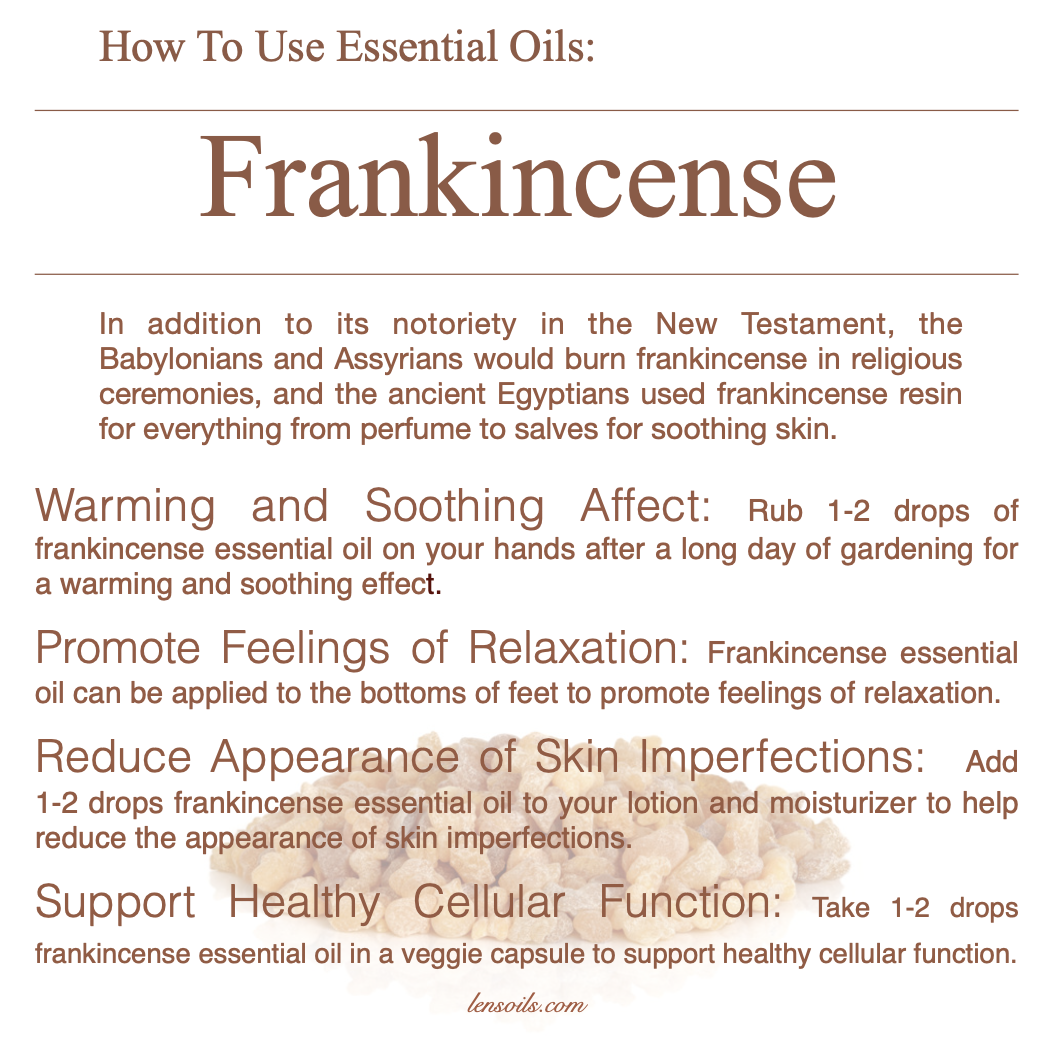
Frankincense essential oil, distilled from the resin of the Boswellia tree, is one of the most treasured oils in history, prized for its warm, spicy, and slightly woody aroma. Native to the Arabian Peninsula and parts of Africa, frankincense has been used for thousands of years in spiritual ceremonies, religious rituals, and natural medicine. In essential oil form, its grounding fragrance is often diffused to promote feelings of peace, relaxation, and spiritual connection. Its timeless aroma makes it one of the most versatile oils for both body and soul.
Beyond its spiritual heritage, frankincense essential oil is widely used in modern wellness practices. It is often added to skin care products for its rejuvenating properties, supporting healthy, radiant-looking skin. In aromatherapy, it blends beautifully with citrus oils like bergamot for uplifting balance, or with grounding oils like sandalwood for meditation and calm. Frankincense is also valued for supporting clear breathing and creating a soothing environment, making it a staple in both personal and household blends.
Did You Know? Frankincense is famously known as one of the gifts of the Magi brought to the Christ child, giving it a strong connection to Christmas and spiritual traditions. In ancient times, it was more valuable than gold and was traded across the Middle East and North Africa. The resin was burned in temples and sacred spaces as a symbol of prayer and devotion, and its use continues today in churches and ceremonies worldwide. Its enduring reputation as the “king of oils” reflects its blend of sacred history and practical benefits.
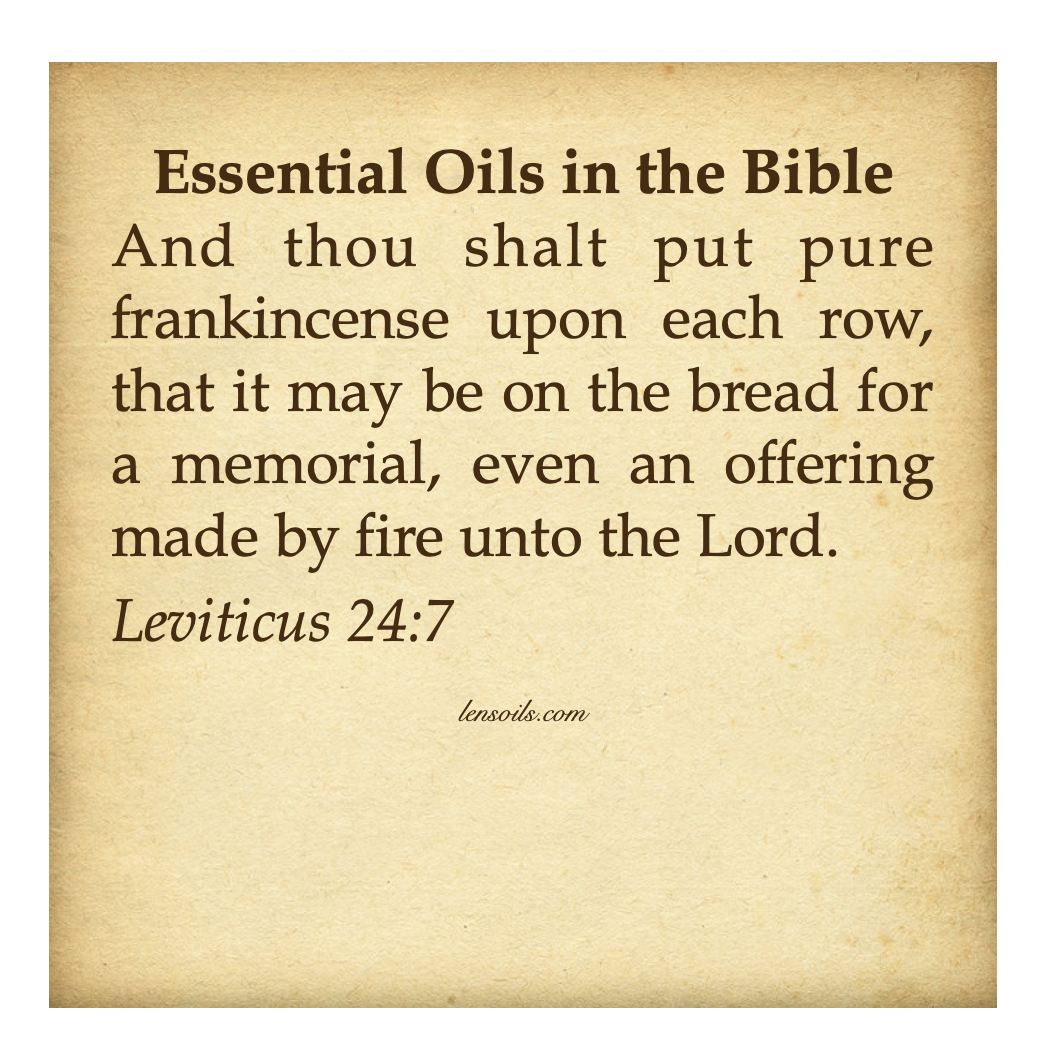
“And thou shalt put pure frankincense upon each row, that it may be on the bread for a memorial, even an offering made by fire unto the Lord.” — Leviticus 24:7
Frankincense held a sacred role in Israel’s worship, not merely for its fragrance but for what it represented. The instruction to place pure frankincense on the bread of the Presence was deeply symbolic—its aroma rising like prayer, connecting worshippers to God. The scent of burning resin was more than pleasant; it was an offering of devotion and remembrance, a way of setting apart holy things as belonging to the Lord.
Historically, frankincense was harvested from the Boswellia tree and considered among the most precious resins of the ancient world. It was imported across desert trade routes and often reserved for temples and royal courts. In biblical times, its costliness highlighted the value of devotion and reverence. Today, frankincense essential oil is still treasured for its calming and centering qualities, reminding us of how its sacred use in the Bible linked daily life with worship and reverence before God.
Please text Free Sample or call me at 801-661-4786 I will be sure to get back to you as soon as possible. Or Send me an email at lfish64@yahoo.com with the heading Free Sample It will be an honor to help you in any way that I can. Or Write me a letter, request a Free Sample Leonard Fish 5075 Rushton Acres Court West Valley City, Utah 84120 USA
In Matthew 2:11, the wise men brought treasures of gold, frankincense, and myrrh to the Christ child. These gifts were far more than valuable commodities—they carried deep symbolic meaning. Gold was a gift fit for a king, but frankincense and myrrh were essential oils highly prized in the ancient world. Frankincense, harvested from the resin of the Boswellia tree, was central in Hebrew worship. It was burned on the altar of incense in the Temple (Exodus 30:34-36) and represented prayer rising to God. Myrrh, drawn from the resin of the Commiphora tree, had multiple uses: as a perfume, in anointing oils, and even in embalming. Together, frankincense and myrrh pointed to Jesus’ dual role: frankincense as a sign of His priestly and divine nature, and myrrh foreshadowing His suffering and sacrificial death.
Historically, these oils were among the most valuable substances in the ancient Near East. They were traded along caravan routes stretching from Arabia and East Africa into Israel, often worth their weight in gold. Kings and priests used them in ceremonies, and healers prized them for medicinal purposes. For the Magi to present such costly oils to the young Jesus was both a gesture of immense honor and a prophetic symbol of His mission. Today, frankincense and myrrh essential oils are still used for their aromatic, calming, and restorative properties—echoing their sacred and timeless history. Their presence in the story of the Nativity reminds us that God’s plan was written not only in scripture but also in the fragrances and treasures of the ancient world.



 Len's Oils