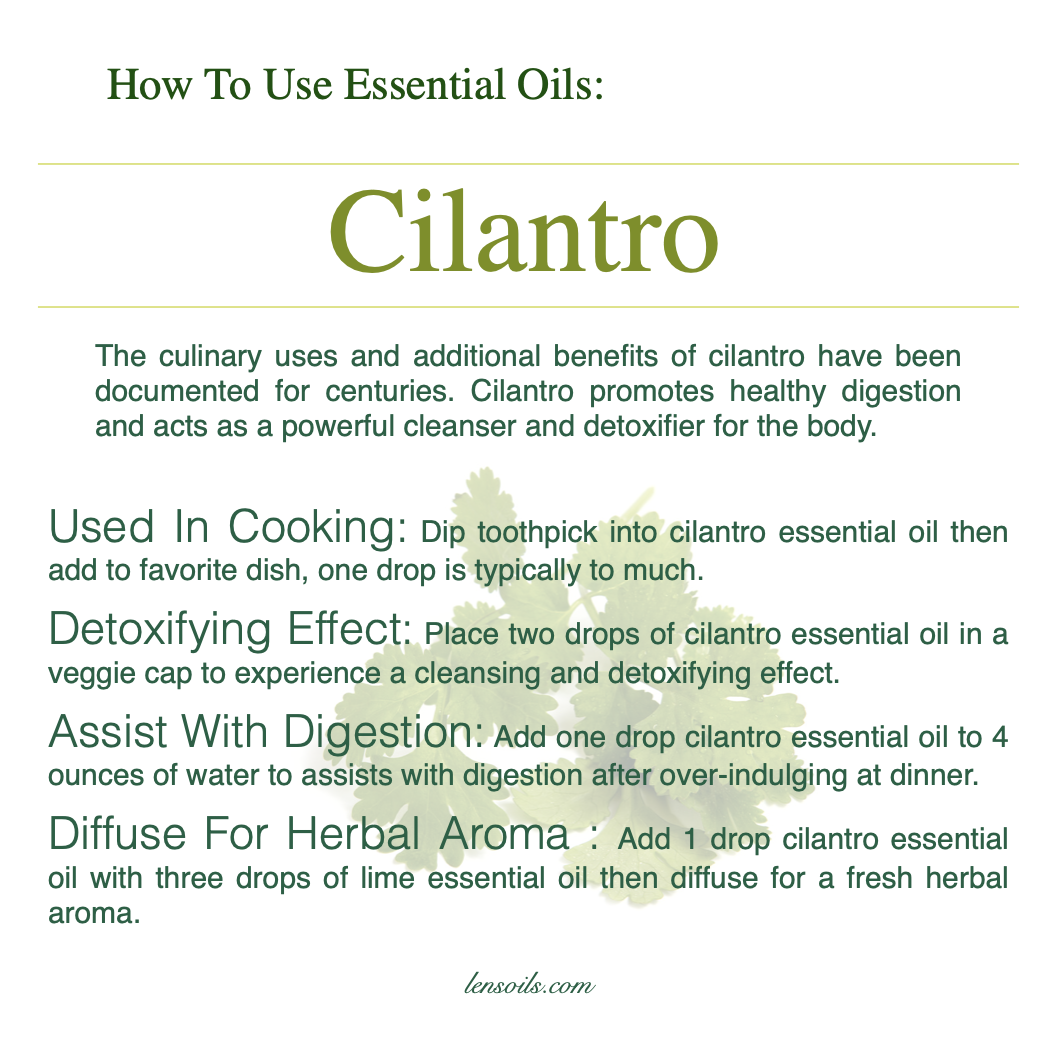
Cilantro (Coriandrum sativum) has been used in culinary and medicinal traditions for centuries, valued for both its distinctive flavor and health-supporting properties. Known for its fresh, herbaceous aroma, cilantro is widely used in cooking, particularly in Mexican, Middle Eastern, and Asian cuisines. The essential oil, derived from cilantro leaves, is highly concentrated, and a small amount goes a long way. A common method for culinary use is dipping a toothpick into cilantro essential oil and stirring it into dishes, as even one full drop may be too strong. Beyond its culinary appeal, cilantro essential oil is believed to promote digestion and help detoxify the body. Some practitioners suggest placing two drops of cilantro essential oil in a veggie capsule to support natural cleansing processes. While cilantro has been traditionally used for detoxification, more scientific studies are needed to validate its direct impact on heavy metal removal and long-term detox benefits.
Cilantro essential oil is also frequently used for digestive support. Many individuals add one drop to four ounces of water to assist digestion after a heavy meal, a practice based on cilantro’s traditional use in easing bloating and occasional stomach discomfort. Additionally, diffusing one drop of cilantro essential oil with three drops of lime essential oil can create a refreshing herbal aroma, often used to promote a sense of freshness and mental clarity. Some aromatherapists believe that cilantro’s invigorating scent may also contribute to emotional balance and stress reduction. While these benefits are widely supported by holistic wellness practices, further clinical research is required to fully understand cilantro essential oil’s physiological effects on digestion and mood enhancement.
Beyond its culinary and detoxifying properties, cilantro essential oil is being explored for its potential antibacterial and antimicrobial effects. Some studies suggest that cilantro oil contains compounds that may help inhibit certain bacteria, making it a potential natural preservative. It has also been traditionally used in folk medicine for immune support, though its efficacy compared to standard antimicrobial treatments remains an area of study. Despite these uncertainties, cilantro essential oil remains a highly versatile oil, offering culinary, digestive, and aromatic benefits, making it a valuable addition to natural wellness practices.
René-Maurice Gattefossé, born in 1881 in Montchat, Lyon, France, was a French chemist whose pioneering work laid the foundation for modern aromatherapy. Raised in a family of perfumers, Gattefossé grew up surrounded by the scents and intricacies of essential oils. This environment cultivated his early fascination with chemistry and the natural properties of plant extracts. After earning his degree in chemical engineering, he began working in his family’s perfumery business, where he honed his understanding of the aromatic compounds that would later define his career.
In the early 20th century, Gattefossé devoted himself to researching essential oils, initially focusing on their applications in perfumery. During this time, essential oils were primarily valued for their fragrances rather than their therapeutic properties. However, his scientific curiosity pushed him to investigate the chemical composition and potential medicinal uses of these oils. This transition from perfumery to therapeutics marked the beginning of a groundbreaking journey that would redefine the use of essential oils.
Gattefossé’s interest in the therapeutic potential of essential oils was significantly influenced by a life-altering incident in 1910. While working in his laboratory, he suffered a severe burn on his hand after an accidental explosion. In desperation, he plunged his hand into a nearby vat of lavender oil. To his surprise, the pain subsided almost immediately, and the wound healed rapidly without infection or scarring. This experience convinced him of the profound healing properties of essential oils and motivated him to study their medicinal benefits more deeply.
After the lavender oil incident, Gattefossé redirected his focus toward the therapeutic properties of essential oils. He began collaborating with physicians, chemists, and botanists to document the physiological and psychological effects of various oils. His research revealed that essential oils possessed antibacterial, antifungal, and anti-inflammatory properties, which could be used to treat a wide range of ailments. This work was revolutionary, as it marked one of the first systematic attempts to bridge traditional plant medicine with modern scientific methods.
Gattefossé coined the term “aromatherapy” in 1928, combining the words “aroma” and “therapy” to describe the use of essential oils for healing. His landmark book, Aromathérapie: Les Huiles Essentielles Hormones Végétales (1937), was the first to systematically document the medicinal uses of essential oils. In this work, he detailed the therapeutic effects of numerous oils, including lavender, rosemary, thyme, and eucalyptus. His findings laid the groundwork for modern aromatherapy, inspiring future generations of researchers and practitioners.
During World War I, Gattefossé worked closely with military physicians to treat wounded soldiers using essential oils. He provided oils like thyme and lavender for disinfecting wounds and preventing infections, demonstrating their efficacy in battlefield conditions. This period solidified his belief in the medicinal potential of essential oils and showcased their practical applications in medical care.
Beyond his scientific contributions, Gattefossé was a strong advocate for integrating aromatherapy into mainstream medicine. He believed that essential oils offered a natural and effective alternative to synthetic drugs, especially for treating infections and skin conditions. His vision was to create a holistic approach to medicine that combined traditional remedies with modern scientific understanding, emphasizing the importance of treating the whole person rather than just the symptoms.
Despite facing skepticism from the medical community, Gattefossé remained committed to his research and advocacy. He traveled extensively, sharing his findings at conferences and collaborating with international experts. His work gained recognition among a growing circle of health professionals, setting the stage for the eventual acceptance of aromatherapy as a legitimate field of study.
René-Maurice Gattefossé’s legacy as the father of aromatherapy continues to influence the field today. His pioneering research and dedication to understanding the healing power of essential oils transformed them from mere fragrances into powerful therapeutic tools. His contributions laid the scientific foundation for aromatherapy, inspiring countless researchers, practitioners, and enthusiasts to explore the natural healing potential of plants.
By the time of his death in 1950, Gattefossé had established a lasting legacy that would shape the future of natural medicine. His work bridged the gap between ancient traditions and modern science, ensuring that aromatherapy would endure as both an art and a science. Today, his name is synonymous with the field he helped create, reminding us of the profound impact that one person’s curiosity and dedication can have on the world.
Did you know Angelica is the oil of spiritual opening. Angelica essential oil acts as a spiritual guide. It opens the soul to spirituality by giving support to everyone that is on a path with their True Self, and with their higher power. Angelica assists in healing a wide range of spiritual issues such as lack of faith, feeling spiritually manipulated, or controlled by others, or feeling cut off from Divine love. It encourages a willingness to open the mind, and see spirituality in a new light.
According to one European legend, Angelica was shown in a dream by an angel to cure the plague. This is the reason this plant was named Angelica. All parts of the plant were believed to be effective against evil spirits and witchcraft. It was held in such high regard that it was called ’The Root of the Holy Ghost.’
Angelica is used a lot in the world of herbal medicine. It is useful in the treatment of fevers, colds, coughs, flatulent colic, and other stomach disorders. Externally it is used as a medicinal gargle for sore throats, and mouths and as a medicinal poultice for broken bones, swellings, itching, and rheumatism. It has been studied for antibacterial properties which help to prevent the growth of various bacteria. Angelica should not be taken in large quantities by pregnant women.
Did you know the Arborvitae has been referred to as the tree of life? A native North American western red cedar tree, can reach 180 to 200 feet in height in some areas of the Northwest but is more often seen at 50 to70 feet in height with a spread of 15 to 25 feet in width. Forming an upright pyramidal silhouette with strongly horizontal branches, Giant-Cedar is an evergreen with fragrant, dark green, delicate needles. This very rare Western Red Cedar will put on 3 to 5 feet of growth per year.
The arborvitae has been used by ancient civilizations to enhance their potential for spiritual communication during rituals and other ceremonies. Modern technology however has revealed that giant Arborvitae essential oil contains high levels of unique compounds called tropolones. Tropolones are an unusual seven membered carbon ring structure not found in significant concentrations in other essential oils. It is these tropolones that yield the unique therapeutic qualities of this oil.
When selecting a source of Arborvitae essential oil, one must be sure to choose a source whose oil does not contain thujone, a neurotoxic compound. Besides source geography, it is also essential to consider the plant part from which this oil is distilled: only essential oil from the wood of Arborvitae has been found to be free from thujone. When sampled and tested for thujone, essential oil from the wood of Arborvitae grown in the Pacific Northwest was found to have no thujone, indicating that oil from this region is safe for human use.
Arborvitae has been used for coughs, fevers and intestinal parasites. It also has antibacterial, and anti-fungal properties. Arborvitae is calming, and has been used as an insect repellent. This oil may also help with skin nourishing and sunscreen. It has a strong effect on the subconscious and unconscious mind.
Did you know Angelica is the oil of spiritual opening. Angelica essential oil acts as a spiritual guide. It opens the soul to spirituality by giving support to everyone that is on a path with their True Self, and with their higher power. Angelica assists in healing a wide range of spiritual issues such as lack of faith, feeling spiritually manipulated, or controlled by others, or feeling cut off from Divine love. It encourages a willingness to open the mind, and see spirituality in a new light.
According to one European legend, Angelica was shown in a dream by an angel to cure the plague. This is the reason this plant was named Angelica. All parts of the plant were believed to be effective against evil spirits and witchcraft. It was held in such high regard that it was called ’The Root of the Holy Ghost.’
Angelica is used a lot in the world of herbal medicine. It is useful in the treatment of fevers, colds, coughs, flatulent colic, and other stomach disorders. Externally it is used as a medicinal gargle for sore throats, and mouths and as a medicinal poultice for broken bones, swellings, itching, and rheumatism. It has been studied for antibacterial properties which help to prevent the growth of various bacteria. Angelica should not be taken in large quantities by pregnant women.
For years I have suffered with canker sores. For all of you who don’t know how painful a canker sore is, this is a pain that doesn’t stop, coming from the depths of your soul. This is a pain that starts out slow and lasts long. In fact canker sores can last up to three weeks. No sooner would one canker sore start to heal, then another one would form. Sometimes I could have as many as three canker sores in my mouth at one time.
Canker sores appear to be brought on by many types of stress, either emotional, physical, or chemical. Emotional stress can be caused by any situation that puts you under pressure. Physical stress might be caused by an abrasion in your mouth, burns from hot foods, or even biting your tongue or cheek. Chemical stress means anything that changes your body chemistry, such as an illness or a change in your eating habits.
There are two things I have found that are very helpful with my canker sores. First I take L-Lysine. This is a very important amino acid that you can find in the vitamin section of the grocery store. The second thing I use is melaleuca essential oil. I rub this oil on my canker sores. It numbs my canker sores. Melaleuca essential oil is a very powerful oil. It is antibacterial, anti-fungal, and anti-infectious. Since I started using melaleuca essential oil the length of time I have a canker sore is a lot less. Who would have thought the oil in a small bottle would be so effective?


 Did you know the Arborvitae has been referred to as the tree of life? A native North American western red cedar tree, can reach 180 to 200 feet in height in some areas of the Northwest but is more often seen at 50 to70 feet in height with a spread of 15 to 25 feet in width. Forming an upright pyramidal silhouette with strongly horizontal branches, Giant-Cedar is an evergreen with fragrant, dark green, delicate needles. This very rare Western Red Cedar will put on 3 to 5 feet of growth per year.

 Len's Oils