Tag Archives: Rene-Maurice Gattefosse

Secrets of the Silent Giant and the Rest of the Story

High in the mist-covered mountains of Lebanon, King Solomon’s builders labored. They sought wood that would withstand centuries, wood that was resistant to decay and filled the air with an unmistakable aroma. They chose carefully, for this wood would line the halls of the most magnificent temple ever built. It was a tree known for its strength, durability, and fragrance—a tree that had already been revered for generations.

Far to the south, the priests of Egypt knew of this tree as well. It was not merely prized for its timber but for something more—the oil that could be extracted from its heartwood. The Egyptians used this oil to embalm their dead, believing it would preserve not just the body, but the soul. The tombs of Pharaohs bore the scent long after their earthly kings had turned to dust.

Centuries later, the Roman scholar Pliny the Elder wrote of its properties. He documented its resistance to rot and insects, its deep, grounding fragrance, and the way its oil was used to anoint sacred objects. The Romans burned shavings of its wood in temples, letting the aroma drift skyward with their prayers.

In the American colonies, settlers recognized the same properties. They lined their closets with this wood, filling storage chests with its shavings. Why? Because its scent repelled moths and insects, protecting precious linens and heirlooms for generations. Even today, small blocks of this wood are placed in closets for the same reason.

By the 20th century, chemists began to examine the oil more closely. Among them was René-Maurice Gattefossé, the French scientist who pioneered aromatherapy. He recognized this oil’s ability to promote relaxation and soothe the mind. Blended into massage oils or diffused into the air, it provided a sense of calm after a long, weary day.

Meanwhile, outdoorsmen took note of another quality. Hikers and campers began using the oil as a natural insect repellent. A drop on a cotton ball, tucked into a tent or sleeping bag, kept unwanted pests at bay. It was yet another way this tree protected those who sought its benefits.

Modern dermatologists discovered its skincare potential. With astringent properties, it became a trusted ingredient in facial treatments, helping with oily skin. Those who suffered from occasional skin irritation found that just a few drops blended into lotions or carrier oils could provide relief.

And in households around the world, its scent filled the air—not just in wooden furniture, but in diffusers, candles, and soaps. It became a staple in spas, helping people unwind from the pressures of daily life. It was the quiet companion of relaxation, as it had been for thousands of years.

And now, with all the clues before you—the ancient temples, the chests lined with fragrant wood—you might think we’re talking about sandalwood or pine. But no, the unsung hero of this story is Cedarwood. With its grounding aroma and remarkable benefits, it has touched lives for centuries.

And now you know the rest of the story.

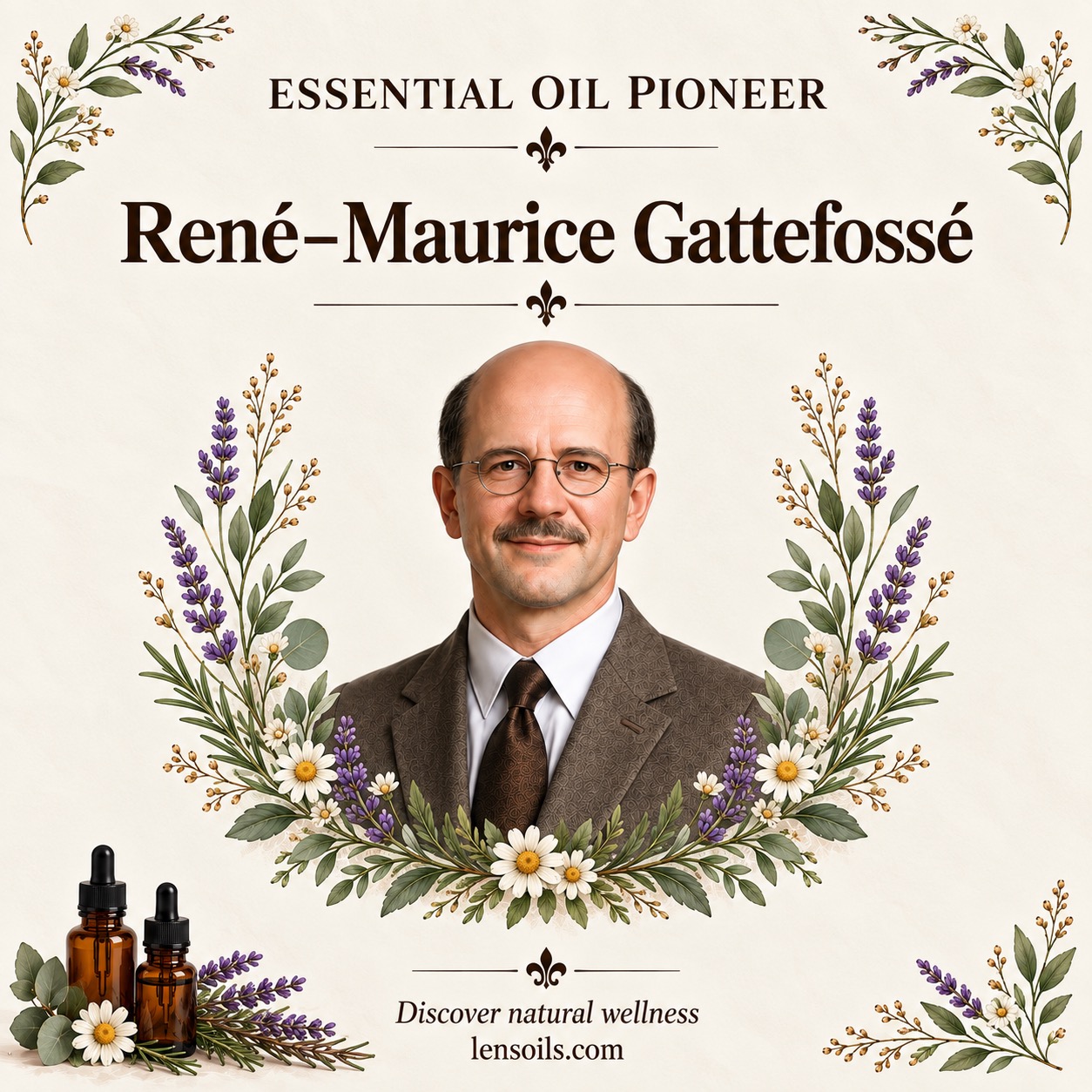
Essential Oil Leader Spotlight: René-Maurice Gattefossé

Essential Oils Heritage Collection cover featuring amber essential oil bottles surrounded by lavender, chamomile flowers, green herbs, and a sliced orange.

Essential Oils Heritage Collection explores the history, uses, and traditions of essential oils through practical guidance, inspiring stories, and thoughtful insights that celebrate nature’s remarkable gifts for everyday living.

Essential Oils Heritage Collection cover featuring amber essential oil bottles surrounded by lavender, chamomile flowers, green herbs, and a sliced orange.

René-Maurice Gattefossé, born in 1881 in Montchat, Lyon, France, was a French chemist whose pioneering work helped lay the foundation for modern aromatherapy. Raised in a family of perfumers, he grew up surrounded by the fragrances and craftsmanship of essential oils. This early exposure sparked a lifelong fascination with chemistry and the remarkable properties of aromatic plants. After earning his degree in chemical engineering, he joined his family’s perfumery business, where he developed a deep understanding of the aromatic compounds that would later define his career.

In the early 1900s, Gattefossé devoted himself to studying essential oils, initially focusing on their role in perfumery. At the time, these oils were prized primarily for their fragrance rather than their potential applications beyond scent. His scientific curiosity, however, led him to investigate their chemical composition and explore how they might be used in new ways. That curiosity marked the beginning of a journey that would influence generations of researchers.

One event became closely associated with his life’s work. In 1910, Gattefossé was seriously burned during a laboratory explosion. According to his own account, he immersed his injured hand in lavender essential oil after the accident. The experience made a lasting impression on him and convinced him that essential oils deserved much deeper scientific investigation. Rather than dismissing the event as an isolated occurrence, he committed himself to studying their properties through careful research.

Following this experience, Gattefossé collaborated with physicians, chemists, and botanists to better understand essential oils. His investigations explored their chemical makeup and documented observations about their potential uses. His work helped bridge centuries of traditional plant knowledge with emerging scientific methods, bringing greater attention to essential oils within the scientific community.

In 1928, Gattefossé introduced the term “aromatherapy,” combining the words aroma and therapy to describe the study and use of essential oils. His landmark book, Aromathérapie: Les Huiles Essentielles Hormones Végétales(1937), became one of the first comprehensive works devoted to the subject. It documented oils such as lavender, rosemary, thyme, and eucalyptus while encouraging further scientific investigation into their properties.

During World War I, Gattefossé continued exploring practical applications for essential oils while working alongside physicians who were interested in wound care and hygiene. These experiences strengthened his belief that essential oils merited continued scientific study and demonstrated their growing importance beyond the perfume industry.

Gattefossé also believed that traditional botanical knowledge and modern science could complement one another. He encouraged researchers to examine essential oils with both curiosity and scientific rigor, promoting a more holistic understanding of plant-based medicine while recognizing the importance of careful observation and ongoing research.

Although many in the medical community remained skeptical during his lifetime, Gattefossé continued publishing his findings, collaborating with researchers, and sharing his work throughout Europe. Over time, his contributions earned growing respect and inspired future scientists, healthcare professionals, and aromatherapists to continue exploring the field.

René-Maurice Gattefossé passed away in 1950, but his influence continues today. His curiosity, scientific mindset, and willingness to question conventional thinking helped transform essential oils from ingredients valued mainly for fragrance into a respected field of study. More than a century later, his name remains closely connected with the development of modern aromatherapy and the ongoing exploration of nature’s remarkable aromatic plants.

Continue exploring the Essential Oil Leader Spotlight series to discover the pioneers, researchers, and educators whose curiosity and dedication helped shape our understanding of essential oils.

The Indigo Secret

In the early 1940s, World War II was raging, and the people of England were bracing themselves for the worst. Amid the chaos and fear, one young woman named Marguerite Maury was quietly working in her small Parisian laboratory, surrounded not by weapons or blueprints for war but by plants—hundreds of them. Marguerite was a biochemist and an avid believer in the power of natural remedies. But her fascination wasn’t merely scientific—it was personal. She had suffered from chronic illness as a child and found solace in the aromatic compounds of flowers and herbs.

Marguerite’s life took a turn when she came across the work of René-Maurice Gattefossé, a French chemist whose accidental discovery of lavender’s healing properties changed the course of modern aromatherapy. Gattefossé had burned his hand during an experiment and instinctively plunged it into a container of lavender oil. To his astonishment, the burn healed quickly, with little scarring. Inspired, Marguerite began to explore the healing potential of other plants, diving deeper into the study of essential oils.

Her research led her to a plant that, at first glance, seemed utterly unremarkable. It grew wild in the sun-soaked fields of Morocco, its yellow blossoms swaying gently in the Mediterranean breeze. Local farmers harvested it for its traditional uses, but Marguerite suspected the plant was capable of far more. She obtained a small sample of its oil and began her experiments. What she discovered would change her life—and the lives of countless others.

The oil was unlike anything Marguerite had ever encountered. Its color was a striking indigo blue, almost otherworldly. Marguerite learned that this unique hue came from a compound called chamazulene, which was only formed during the distillation process. But it wasn’t just the color that intrigued her—it was the oil’s effects. It seemed to calm irritated skin, ease tension, and lift the spirits in ways she had never seen before.

Marguerite decided to test the oil on herself. At the time, she was battling stress and fatigue from long days in her lab. She placed a single drop in a bowl of steaming water, inhaling deeply. The rich, herbaceous aroma filled her senses, and almost immediately, she felt a sense of calm and focus. Over the next few months, she shared the oil with friends and colleagues, documenting its effects on everything from blemishes to sore muscles.

Her breakthrough came when she presented her findings to a group of biochemists in Paris. They were skeptical at first, dismissing her work as nothing more than folk medicine. But Marguerite was undeterred. She had seen the results firsthand—she knew the oil was a gift, not just for healing the body but for restoring the soul. Eventually, her persistence paid off, and the scientific community began to take notice.

By the 1950s, Marguerite Maury had become a pioneer in aromatherapy, and her work with this mysterious blue oil had earned her international recognition. She introduced the concept of using essential oils not just for their physical benefits but for their emotional and psychological effects—a radical idea at the time. Her discoveries paved the way for modern holistic medicine, changing how people viewed the connection between plants and healing.

And the plant that started it all? The humble blue tansy, also known as Moroccan tansy. Today, it’s cherished for its skin-soothing properties, its ability to uplift the mood, and its role in Marguerite Maury’s groundbreaking legacy.

And now you know the rest of the story.

Essential Oils Throughout History

Essential oils have been used throughout recorded history for a wide variety of wellness applications. The Egyptians were some of the first people to use aromatic essential oils extensively in medical practice, beauty treatment, food preparation, and in religious ceremony. Frankincense, sandalwood, myrrh and cinnamon were considered very valuable cargo along caravan trade routes and were sometimes exchanged for gold.

Borrowing from the Egyptians, the Greeks used essential oils in their practices of therapeutic massage and aromatherapy. The Romans also used aromatic oils to promote health and personal hygiene. Influenced by the Greeks and Romans, as well as Chinese and Indian Ayurvedic use of aromatic herbs, the Persians began to refine distillation methods for extracting essential oils from aromatic plants. Essential oil extracts were used throughout the dark ages in Europe for their anti-bacterial and fragrant properties.

In modern times, the powerful healing properties of essential oils were rediscovered in 1937 by a French chemist, Rene-Maurice Gattefosse, who healed a badly burnt hand with pure lavender oil. A French contemporary, Dr. Jean Valnet, used therapeutic-grade essential oils to successfully treat injured soldiers during World War II. Dr. Valnet went on to become a world leader in the development of aromatherapy practices. The modern use of essential oils has continued to grow rapidly as health scientists and medical practitioners continue to research and validate the numerous health and wellness benefits of therapeutic-grade essential oil.