Category Archives: Inspirational

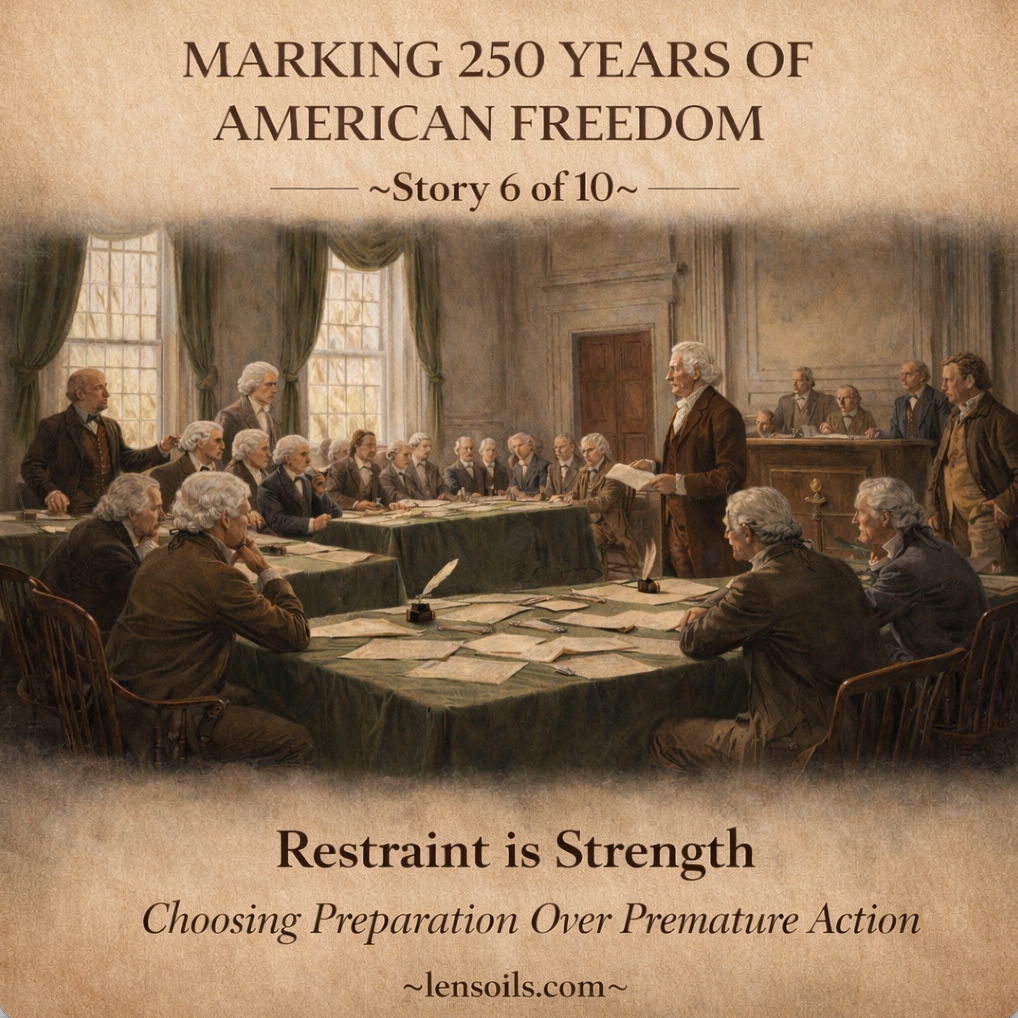
Living With Disagreement

Story 5 of 10 — marking 250 years of American freedom
When Restraint Held a Nation Together

June 7, 1776 brought the question of independence into the open in a way that could no longer be avoided. On that day, Richard Henry Lee introduced a resolution in the Continental Congress calling for the colonies to separate from Britain. The proposal did not create unity. It revealed how divided the colonies already were, even as war continued.

Many colonists feared what independence might cost. Trade ties with Britain supported entire communities, and separation threatened economic collapse. Others worried about foreign invasion or internal disorder. At the same time, those who favored independence believed delay would only strengthen British control. These disagreements existed within families, churches, town councils, and colonial assemblies.

Debate spread quickly beyond Philadelphia. Taverns, markets, and meeting halls became informal political forums where news traveled fast and arguments followed. Letters and diaries from the period describe conversations that were sharp but deeply personal. People understood that the outcome would affect everyone, regardless of which side they favored.

Despite these divisions, daily life forced cooperation. Crops still needed planting, roads needed repair, and barns had to be raised before weather or war made delays costly. Towns required defense, and neighbors who disagreed politically depended on one another for survival. Separation was not only impractical. It was dangerous.

Leaders faced the same reality. Members of Congress argued fiercely over timing and risk, yet they continued working together. They understood that fracturing the colonies before a decision was reached would guarantee failure. Progress depended not on agreement, but on restraint.

What held the colonies together during this period was not agreement on independence, but a shared understanding of consequence. People recognized that allowing disagreement to fracture relationships would weaken their ability to survive what lay ahead. Restraint became a practical skill rather than a moral ideal. Choosing to stay engaged, even while divided, protected the fragile framework that independence would soon require.

This moment shows that disagreement itself was not the greatest threat to independence. The danger was allowing conflict to destroy cooperation. The colonies endured because people chose to remain connected even when unity felt strained. Living with disagreement became a discipline—one that made the final decision possible.

References

  1. Journals of the Continental Congress, June 1776
  2. Pauline Maier, American Scripture: Making the Declaration of Independence
  3. Bernard Bailyn, The Ideological Origins of the American Revolution

These stories are grounded in documented historical events and primary sources, with limited interpretive synthesis used to connect facts and reflect lived experience where the historical record does not capture every detail.


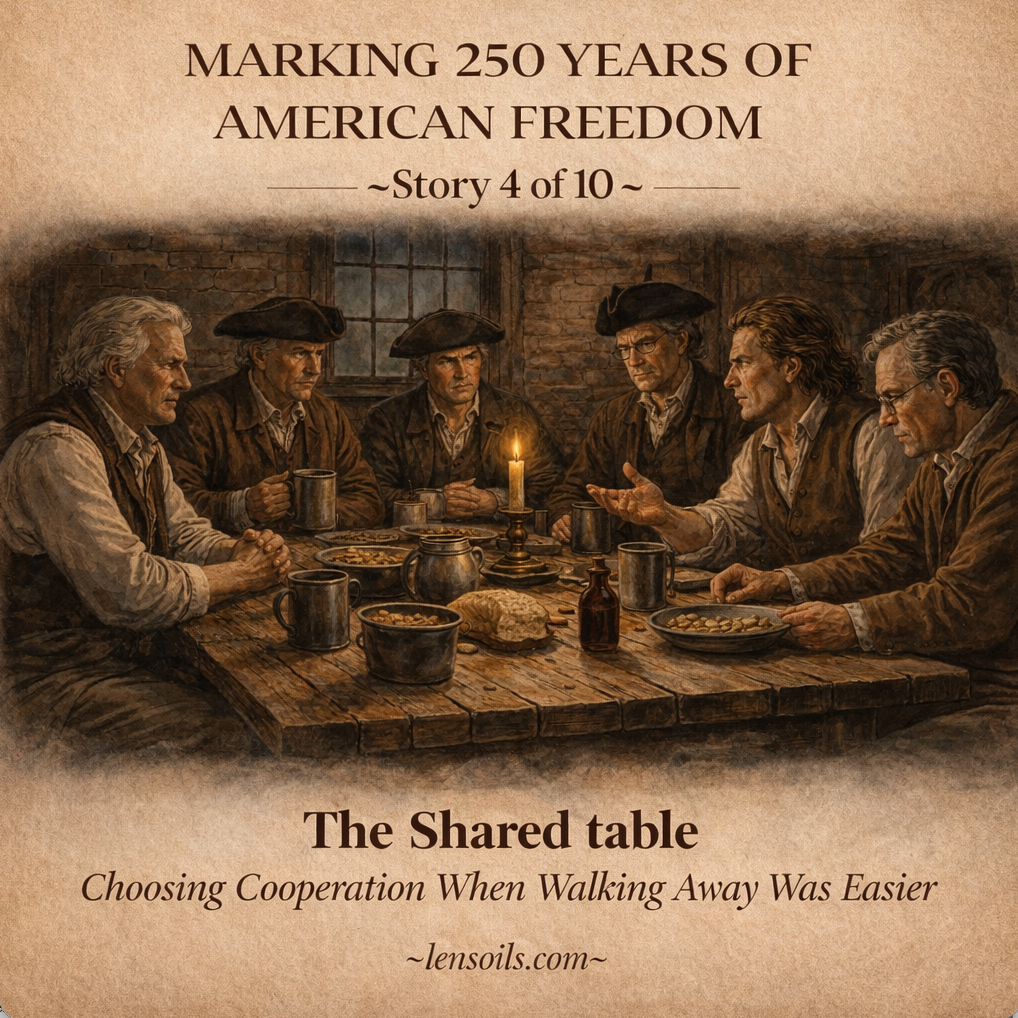
The Shared Table 

Story 4 of 10 — Marking 250 Years of American Freedom
Choosing Cooperation When Walking Away Was Easier

April 22, 1776, found the American colonies still undecided about independence, even as war with Britain continued. Many colonists feared that separation would destroy trade, divide communities, and leave families vulnerable. Others believed that remaining under British rule meant permanent submission. These disagreements were not abstract. They played out in towns, churches, farms, and meeting houses across the colonies.

Food shortages, disrupted commerce, and the presence of troops forced people to depend on one another despite political differences. Communities could not afford isolation. Neighbors needed shared labor to plant crops, defend property, and care for the sick. Disagreement did not pause daily responsibilities, and survival required cooperation even when opinions clashed.

Letters and diaries from the period describe meals shared between people who strongly disagreed about independence. Taverns, homes, and communal tables became spaces where arguments were common but separation was rare. Leaving the table entirely would have weakened everyone. Staying required restraint, patience, and a willingness to remain connected without resolving every dispute.

This pattern appeared beyond local communities. Colonial assemblies continued to function even when deeply divided. Delegates argued forcefully, adjourned without consensus, and returned to continue working together. The goal was not agreement on every point, but maintaining enough unity to prevent collapse.

The ability to remain present during disagreement proved critical. Independence did not advance through constant harmony, but through discipline. People learned that walking away carried consequences greater than staying engaged. Cooperation became an act of responsibility rather than comfort.

This moment reveals a quiet truth about the Revolution. Freedom did not begin with certainty. It grew because people chose connection over exit and participation over isolation. By remaining at the table, even when disagreement was sharp, the colonies preserved the relationships necessary to move forward together.

References

  1. , The Radicalism of the American Revolution
  2. Pauline Maier, From Resistance to Revolution
  3. Journals of the Continental Congress, 1775–1776

These stories are grounded in documented historical events and primary sources, with limited interpretive synthesis used to connect facts and reflect lived experience where the historical record does not capture every detail.

The Midnight Listener

Story 3 of 10 — Marking 250 Years of American Freedom
When Listening Became an Act of Courage

March 17, 1776 marked a turning point in the struggle for independence, as British forces evacuated Boston after months of siege. Ships moved out of the harbor, troops withdrew, and control of the city shifted. While this moment is often remembered for its military significance, it was also shaped by information quietly gathered long before the evacuation took place.

Ports and docks were places where news traveled freely. Sailors, soldiers, laborers, and merchants crossed paths daily, exchanging details without always realizing their importance. British officers often spoke openly near the waterfront, assuming the men loading cargo or repairing ships were uninterested or unaware. That assumption created opportunities few noticed.

One dockworker learned to listen carefully. He kept his eyes down and his reactions hidden while conversations unfolded nearby. He memorized ship names, destinations, troop movements, and supply changes, choosing not to write anything down. Asking questions would have drawn attention. Silence was his protection.

At night, the information was quietly passed along through trusted contacts. No signatures were attached, and no credit was claimed. Accuracy mattered more than speed. Each detail reduced uncertainty for colonial leaders and local militias preparing for what might come next.

These reports helped communities anticipate British actions and protect resources. While no single piece of information decided the outcome of the conflict, together they allowed leaders to act with greater confidence. Preparation depended not only on force, but on awareness.

The risk was real. Discovery could have led to arrest or worse. Yet the work continued because it mattered. Courage during this period often appeared without recognition, shaped by restraint rather than bold action.

This moment reflects a broader truth about the Revolution. Independence did not advance only through famous leaders or decisive battles. It also moved forward through ordinary people who paid attention, stayed disciplined, and acted quietly when uncertainty surrounded them. Listening, in this case, became a form of responsibility that helped prepare a divided people for the decisions still ahead.


References

  1. David McCullough, 1776
  2. National Park Service, Boston National Historical Park — Evacuation of Boston
  3. Benjamin L. Carp, Defiance of the Patriots: The Boston Tea Party and the Making of America

These stories are grounded in documented historical events and primary sources, with limited interpretive synthesis used to connect facts and reflect lived experience where the historical record does not capture every detail.

The Choice That Saved His Life

Aron Ralston loved solitude and challenge, believing that self-reliance was built far from crowds. In the spring of 2003, he traveled alone to a remote slot canyon in Utah, expecting a brief, familiar adventure. He carried climbing gear, a small supply of food and water, and strong confidence in his experience. One detail was missing. He did not leave his exact plans with anyone, trusting preparation more than precaution.

While descending a narrow canyon wall, a massive boulder suddenly shifted. Aron lost his balance, and the rock crushed his right arm against the canyon wall, pinning it tightly. He shouted, but the canyon offered no answer. There was no cell service and no sign of other hikers. Within moments, he understood the seriousness of his situation. Escape was impossible without freeing his arm, and help was nowhere nearby.

Aron spent hours testing every option. He pushed, pulled, twisted, and used his climbing gear to create leverage, but the boulder did not move. As daylight faded, he marked time by carving lines into the canyon wall. He rationed his water carefully, knowing it would not last long. With each passing day, dehydration weakened him, and the silence forced him to confront the reality that no one knew where he was.

As the hours stretched into days, Aron’s thoughts drifted beyond the canyon walls. He imagined family members, future conversations, and moments he had once assumed would always be there. Simple images returned: shared meals, laughter, and unfinished plans. These were not dramatic visions, but reminders of connection. Life beyond the canyon began to feel real again, and he understood survival meant returning to people and experiences that still mattered deeply.

That growing sense of connection reshaped his fear into resolve. Aron realized that remaining trapped was no longer endurance but surrender. Choosing life meant accepting unbearable pain now to protect everything that came after. His thoughts became calm and focused. The decision ahead was not impulsive or desperate. It was deliberate, formed through reflection and responsibility. He understood that survival required action, even when the cost felt unthinkable.

Using a small multi-tool, Aron prepared himself mentally for what he had already accepted. He broke the bones in his arm to make the act possible, then amputated the trapped limb with controlled determination. The pain was extreme, but he stayed conscious by focusing on breath and purpose. This moment was not driven by panic. It was an act of responsibility, claiming ownership of his life and the consequences of his choices.

Freeing himself was only the beginning. Aron rappelled down a canyon wall, then hiked several miles through rough terrain while injured and severely dehydrated. Each step required discipline and focus. He refused to rush, knowing mistakes could cost his life. Eventually, he encountered other hikers who helped him reach safety. Rescue came not through luck, but through persistence, preparation, and the willingness to keep moving despite exhaustion.

During recovery, Aron reflected on what the canyon had taught him. He acknowledged the risks he had taken and the importance of communication and preparation. Independence, he learned, does not mean isolation. Responsibility includes letting others know where you are and understanding that choices carry weight. Rather than feeling defeated, Aron felt grateful. The experience reshaped how he approached adventure, connection, and awareness moving forward.

Aron later shared his story openly, not to shock others, but to teach accountability and resilience. He trained again, returned to climbing, and built a meaningful life shaped by clarity rather than fear. Losing an arm did not end his future. It refined it. Strength, he discovered, is not avoiding mistakes, but responding to them with honesty, courage, and the discipline to grow beyond them.

Taking responsibility can save your life. Aron survived because he faced the truth of his situation, accepted the weight of his choices, and acted with clear purpose rather than denial. His experience shows that responsibility is not about blame or regret. It is about awareness, preparation, and the courage to act when the moment arrives and decisions carry lasting consequences.

The Letter That Wouldn’t Be Burned

Story 2 of 10 — Marking 250 Years of American Freedom
When Courage Refused to Let Hope Be Destroyed

February 9, 1776 came during a harsh New England winter, when fear and uncertainty weighed heavily on the colonies. British forces were still active in Massachusetts, and many families worried about what continued resistance might cost them. Independence had not yet been declared, and no one knew how the conflict would end. In this tense environment, communication between patriot leaders was both dangerous and necessary.

Couriers played an important role during this time. Often young and unnoticed, they traveled long distances on foot or horseback, carrying sealed letters through snow-covered roads and guarded towns. If caught, they could be arrested or punished. Without these messengers, the colonies would struggle to coordinate their actions or share vital information.

One such courier stopped at a farmhouse to escape the winter weather. Homes relied on open fires for warmth, which made accidental blazes a constant danger. When a fire broke out unexpectedly, there was little time to save belongings. As the building filled with smoke, the courier escaped with nothing but the letter pressed tightly under his coat.

In wartime, losing possessions was common, but losing information could be far more serious. Letters often contained instructions, warnings, or plans that could not easily be replaced. If destroyed, they could delay decisions, expose weaknesses, or leave leaders unprepared for what lay ahead.

After weeks of difficult travel, the message reached its destination. No single letter decided the course of the Revolution, but each successful delivery helped maintain cooperation between colonies facing enormous pressure. Resistance depended not only on soldiers and battles, but on steady communication that allowed leaders to respond wisely.

This moment reflects the deeper fears many colonists faced. People worried about losing homes, livelihoods, and family safety if resistance failed. Hesitation was often rooted in responsibility, not weakness. Courage during this time was not always loud or dramatic.

The survival of that letter did not end fear, but it protected hope. Bravery appeared quietly, when someone chose to preserve what mattered most under difficult circumstances. Independence moved forward through such choices, when refusing to let hope be destroyed became an act of strength.


References

  1. Massachusetts Historical Society, Revolutionary War Correspondence and Courier Accounts
  2. Ray Raphael, The First American Revolution: Before Lexington and Concord
  3. George C. Daughan, If By Sea: The Forging of the American Navy from the Revolution to the War of 1812

These stories are grounded in documented historical events and primary sources, with limited interpretive synthesis used to connect facts and reflect lived experience where the historical record does not capture every detail.

THE SEASONS OF LIFE

There was once a thoughtful man who had four sons, each strong-willed and quick to form opinions. Wanting them to understand patience, perspective, and the danger of judging too quickly, he devised a lesson rooted not in lectures, but in lived experience and time.

He sent his sons, one by one, on a long journey to observe a single pear tree growing far away. Each son was sent during a different season, so none of them would see the tree under the same conditions or circumstances.

The first son traveled during the depths of winter, when the air was cold and the ground was bare. When he returned, he described the tree as ugly, twisted, and lifeless, its branches bent and stripped of anything worth admiring.

The second son was sent in early spring, when the earth was slowly waking. He returned with a different account, explaining that the tree was alive with green buds and fresh shoots, quietly full of promise and unseen potential.

The third son went during the height of summer, when warmth and growth were everywhere. He spoke passionately of blossoms covering the tree, filling the air with sweet fragrance, calling it graceful, vibrant, and the most beautiful thing he had ever witnessed.

The youngest son made the journey in autumn, when the year was nearing its close. He returned describing a tree heavy with ripe fruit, drooping under its own abundance, alive with fulfillment, nourishment, and the reward of time patiently endured.

The father listened carefully to each son, then gently explained that none of them were wrong. Each had simply seen the tree in a single season, never realizing that every phase was necessary to complete its full story.

He told them that a tree, like a person, cannot be judged by one moment, one struggle, or one appearance. The true measure of a life is revealed only after all seasons have passed and their lessons are complete.

If you abandon hope during winter, you will never see the promise of spring, the beauty of summer, or the fulfillment of fall. Do not let one difficult season define an entire life, or steal the joy that still lies ahead.

The Winter Printer

Story 1 of 10 — Marking 250 Years of American Freedom
Printing Courage in a Season of Doubt

January 10, 1776 became clear when the pamphlet Common Sense was published in Philadelphia by Thomas Paine. Written in plain language, it argued that monarchy was unjust and that independence was not only possible, but necessary. The colonies were already at war, yet independence had not been declared, and many people still hoped for reconciliation with Britain. Fear and uncertainty shaped daily life, and unity remained fragile.

During these winter weeks, printed words became one of the most powerful tools available. Pamphlets, broadsides, and newspapers carried arguments, warnings, and appeals across colonial towns. Printing presses worked long hours despite shortages of paper, ink, and money. Printers understood that what they produced could influence public opinion, even as it placed them under scrutiny.

One such printer worked late into the night, setting type by hand in a cold shop lit by candles. British patrols still moved through nearby streets, and printing political material carried real risk. Yet presses continued to run, producing pamphlets that called for shared purpose rather than submission or fear. These pages did not promise victory. They asked readers to consider responsibility.

The words traveled far beyond the city. Farmers read them by firelight, shopkeepers shared them with customers, and soldiers passed them between camps. Many readers had never seen the members of Congress or spoken with colonial leaders. What reached them instead were ideas—arguments about liberty, self-rule, and the cost of hesitation.

At the time, these printed appeals did not create immediate agreement. Colonies remained divided, and opinions shifted slowly. But the steady circulation of ideas helped establish a common language. Even among disagreement, people began to recognize shared concerns and shared risks. Unity, when it appeared, did so gradually.

This period shows that independence did not advance only through declarations or battles. It also moved through quiet, persistent effort by ordinary people willing to act without certainty. Long before July 1776, freedom was carried forward by those who chose truth over comfort, even when the outcome was unknown.

What happened in those winter print shops did not resolve the colonies’ disagreements, but it made honest debate unavoidable. Words carried responsibility before freedom carried celebration. Long before independence was declared, people were already practicing it by choosing to think, question, and speak for themselves. That quiet discipline, repeated day after day, prepared a divided people to face the harder decisions still ahead.

References
David McCullough, 1776
Thomas Paine, Common Sense (1776), Library of Congress
Pauline Maier, American Scripture: Making the Declaration of Independence

These stories are grounded in documented historical events and primary sources, with limited interpretive synthesis used to connect facts and reflect lived experience where the historical record does not capture every detail.
The Quiet Experiment

 In 1942 Vienna, Viktor Frankl was a respected psychiatrist with a growing practice, a nearly complete manuscript, and a wife named Tilly whose laugh could fill a room and brighten the darkest days. He had a visa to escape to America, but his elderly parents couldn’t come—so he stayed. Within months, the Nazis came for them all. Theresienstadt. Then Auschwitz. Then Dachau. The manuscript he had sewn into his coat was torn away within hours. His name erased. His number: 119104. 

But what the guards didn’t understand was this: you can take a man’s manuscript, his name, his possessions—but not what he knows. Frankl knew something about the human mind that would change psychology forever. In the camps, men didn’t just die from starvation or disease; they died from giving up. When a prisoner lost his reason to live—his why—his body followed soon after. But those who held onto meaning—a promise to keep, a family to find, a purpose unfinished—found strength to endure.

Frankl began a quiet experiment in the barracks. He couldn’t offer food or freedom, but he whispered to the hopeless: “Who is waiting for you?” “What work is left unfinished?” “What would you tell your son about surviving this?” He helped men remember their purpose. One thought of his daughter and survived to find her. Another recalled a scientific problem and lived to solve it. Frankl himself survived by mentally reconstructing his lost manuscript, line by line, in the darkness.

When liberation came in April 1945, Viktor weighed only 85 pounds. His wife, mother, and brother were gone. Everything he loved—gone. Yet, instead of collapsing, he began writing again. In just nine days, he recreated the manuscript from memory, now filled with something new: proof. He called his theory Logotherapy—therapy through meaning—and showed that humans can survive almost anything if they have a reason to live.

Published in 1946 as “Man’s Search for Meaning,” the book was first rejected as too grim. But slowly it spread. Therapists wept. Prisoners found hope. Ordinary people facing illness, grief, or loss discovered that their pain could still hold purpose. The book has sold over 16 million copies, translated into more than 50 languages, and remains one of the most influential works ever written about resilience and the human spirit.

Because Viktor Frankl proved what the Nazis could not destroy: that even when everything is taken—freedom, family, food, future—one final freedom remains: the freedom to choose what it all means. His words still guide those in despair: “When we are no longer able to change a situation, we are challenged to change ourselves.” Prisoner 119104 didn’t just survive. He turned suffering into healing—and taught the world that meaning is the one thing no one can ever take away.

Life is Like a Train

Life Is Like a Train
Credit – Echoes of Insight

My grandma had a saying she repeated often: “Life is like a train, child. You don’t stay at every stop, and not everyone rides with you until the end.” As a child, I didn’t really understand what she meant, but now, as the years pass and my own hair turns gray, I see the deep truth in her words.

When you’re young, the train is loud, fast, and crowded. Everyone seems to be on board—friends from school, neighbors, coworkers, and family. The compartments are filled with laughter, excitement, and plans that make it feel like the ride will last forever.

As the journey continues, people begin to get off at different stops. Some leave because their path takes them elsewhere, while others are lost suddenly, leaving behind empty seats we can’t bear to look at. With time, the train feels quieter, and we start to understand how precious every shared mile truly was.

That’s when Grandma’s wisdom comes alive inside me. She said the secret wasn’t to mourn every passenger who leaves, but to treasure the ones still sitting beside you. Her voice reminds me to look out the window and notice the scenery that’s always changing.

There are sunrises, fields, cities, mountains, and long stretches of open sky—all part of the same ride. Each moment, like each passenger, has its own season and beauty. The view outside keeps shifting, teaching us to appreciate what’s here before it’s gone.

Now, when I visit her memory in my heart, I can almost hear her voice again. “Don’t be afraid when the train empties out,” she said gently. “Be grateful you had company for as long as you did, and when your stop finally comes, step off with peace.”

Life truly is like a train—filled with comings and goings, goodbyes and reunions. It carries moments of noise and stretches of silence that teach us who we are. By the time we reach the last station, we realize the ride was beautiful not because it was perfect, but because it was ours.

Whispers and Mirrors

It begins softly, like a breeze brushing the edge of a curtain—someone’s name, spoken too easily, carried just far enough to change its shape. Gossip never enters loudly; it slips in disguised as connection, as curiosity, as “just something I heard.” Yet what begins in casual conversation can end in quiet destruction. A life reduced to fragments of rumor. A heart weighed by stories it never told.

We tell ourselves it’s harmless, that sharing makes us part of something, that being “in the know” gives us worth. But every whisper takes from the soul, a small withdrawal from our better selves. When we pass along a scandal, we hold the same shovel that digs another’s hole. The thrill of telling fades fast, and all that’s left is the echo of what we’ve broken.

The Tao says, “What is a bad man but a good man’s job?” I think of that often. How many times I’ve been both—the one who faltered and the one who judged. It’s easy to point a finger; it’s harder to hold a hand. To see the “bad” in someone else is to forget the lessons written quietly into our own scars.

Once, I heard someone laugh, “If a friend’s mad at me, I just say, ‘I have some juicy gossip.’” My heart sank. How sad, I thought, that healing has been replaced by distraction, that love could be bought with cruelty. We trade compassion for a moment of attention, unaware that every careless word widens the distance between us.

When I hear, “I don’t repeat gossip, so listen carefully,” I feel a shiver of shame for all the times I’ve listened too long. Because gossip is not about others—it’s a mirror. What we say reflects who we are, what we value, and what kind of peace we’re willing to sacrifice.

So let’s be the stillness in the noise, the voice that speaks only love. Let’s choose silence when words can wound. In a world eager to talk, may we become the rare souls who listen with compassion, who lift with language, and who walk gently through the fragile stories of others.