Tag Archives: Pauline Maier

Living With Disagreement

Story 5 of 10 — marking 250 years of American freedom
When Restraint Held a Nation Together

June 7, 1776 brought the question of independence into the open in a way that could no longer be avoided. On that day, Richard Henry Lee introduced a resolution in the Continental Congress calling for the colonies to separate from Britain. The proposal did not create unity. It revealed how divided the colonies already were, even as war continued.

Many colonists feared what independence might cost. Trade ties with Britain supported entire communities, and separation threatened economic collapse. Others worried about foreign invasion or internal disorder. At the same time, those who favored independence believed delay would only strengthen British control. These disagreements existed within families, churches, town councils, and colonial assemblies.

Debate spread quickly beyond Philadelphia. Taverns, markets, and meeting halls became informal political forums where news traveled fast and arguments followed. Letters and diaries from the period describe conversations that were sharp but deeply personal. People understood that the outcome would affect everyone, regardless of which side they favored.

Despite these divisions, daily life forced cooperation. Crops still needed planting, roads needed repair, and barns had to be raised before weather or war made delays costly. Towns required defense, and neighbors who disagreed politically depended on one another for survival. Separation was not only impractical. It was dangerous.

Leaders faced the same reality. Members of Congress argued fiercely over timing and risk, yet they continued working together. They understood that fracturing the colonies before a decision was reached would guarantee failure. Progress depended not on agreement, but on restraint.

What held the colonies together during this period was not agreement on independence, but a shared understanding of consequence. People recognized that allowing disagreement to fracture relationships would weaken their ability to survive what lay ahead. Restraint became a practical skill rather than a moral ideal. Choosing to stay engaged, even while divided, protected the fragile framework that independence would soon require.

This moment shows that disagreement itself was not the greatest threat to independence. The danger was allowing conflict to destroy cooperation. The colonies endured because people chose to remain connected even when unity felt strained. Living with disagreement became a discipline—one that made the final decision possible.

References

  1. Journals of the Continental Congress, June 1776
  2. Pauline Maier, American Scripture: Making the Declaration of Independence
  3. Bernard Bailyn, The Ideological Origins of the American Revolution

These stories are grounded in documented historical events and primary sources, with limited interpretive synthesis used to connect facts and reflect lived experience where the historical record does not capture every detail.

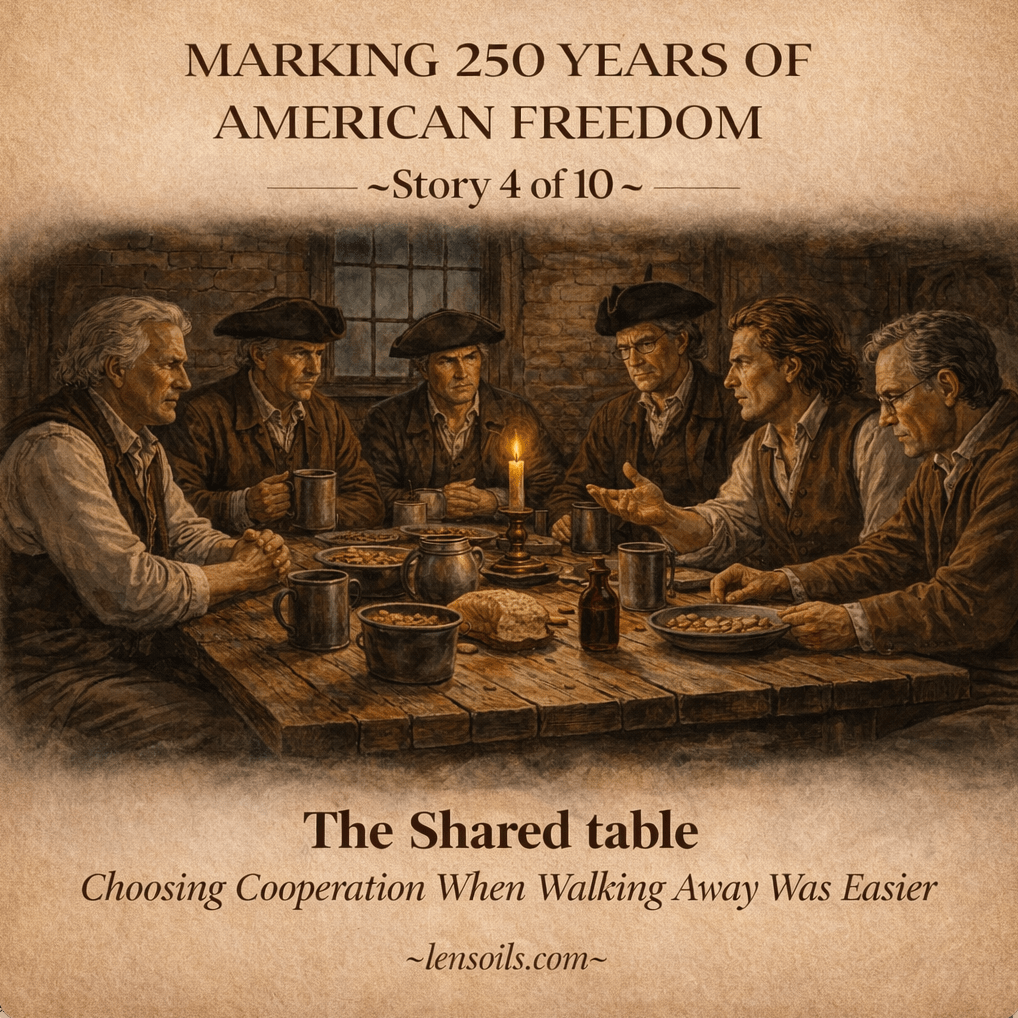
The Shared Table 

Story 4 of 10 — Marking 250 Years of American Freedom
Choosing Cooperation When Walking Away Was Easier

April 22, 1776, found the American colonies still undecided about independence, even as war with Britain continued. Many colonists feared that separation would destroy trade, divide communities, and leave families vulnerable. Others believed that remaining under British rule meant permanent submission. These disagreements were not abstract. They played out in towns, churches, farms, and meeting houses across the colonies.

Food shortages, disrupted commerce, and the presence of troops forced people to depend on one another despite political differences. Communities could not afford isolation. Neighbors needed shared labor to plant crops, defend property, and care for the sick. Disagreement did not pause daily responsibilities, and survival required cooperation even when opinions clashed.

Letters and diaries from the period describe meals shared between people who strongly disagreed about independence. Taverns, homes, and communal tables became spaces where arguments were common but separation was rare. Leaving the table entirely would have weakened everyone. Staying required restraint, patience, and a willingness to remain connected without resolving every dispute.

This pattern appeared beyond local communities. Colonial assemblies continued to function even when deeply divided. Delegates argued forcefully, adjourned without consensus, and returned to continue working together. The goal was not agreement on every point, but maintaining enough unity to prevent collapse.

The ability to remain present during disagreement proved critical. Independence did not advance through constant harmony, but through discipline. People learned that walking away carried consequences greater than staying engaged. Cooperation became an act of responsibility rather than comfort.

This moment reveals a quiet truth about the Revolution. Freedom did not begin with certainty. It grew because people chose connection over exit and participation over isolation. By remaining at the table, even when disagreement was sharp, the colonies preserved the relationships necessary to move forward together.

References

  1. , The Radicalism of the American Revolution
  2. Pauline Maier, From Resistance to Revolution
  3. Journals of the Continental Congress, 1775–1776

These stories are grounded in documented historical events and primary sources, with limited interpretive synthesis used to connect facts and reflect lived experience where the historical record does not capture every detail.

The Winter Printer

Story 1 of 10 — Marking 250 Years of American Freedom
Printing Courage in a Season of Doubt

January 10, 1776 became clear when the pamphlet Common Sense was published in Philadelphia by Thomas Paine. Written in plain language, it argued that monarchy was unjust and that independence was not only possible, but necessary. The colonies were already at war, yet independence had not been declared, and many people still hoped for reconciliation with Britain. Fear and uncertainty shaped daily life, and unity remained fragile.

During these winter weeks, printed words became one of the most powerful tools available. Pamphlets, broadsides, and newspapers carried arguments, warnings, and appeals across colonial towns. Printing presses worked long hours despite shortages of paper, ink, and money. Printers understood that what they produced could influence public opinion, even as it placed them under scrutiny.

One such printer worked late into the night, setting type by hand in a cold shop lit by candles. British patrols still moved through nearby streets, and printing political material carried real risk. Yet presses continued to run, producing pamphlets that called for shared purpose rather than submission or fear. These pages did not promise victory. They asked readers to consider responsibility.

The words traveled far beyond the city. Farmers read them by firelight, shopkeepers shared them with customers, and soldiers passed them between camps. Many readers had never seen the members of Congress or spoken with colonial leaders. What reached them instead were ideas—arguments about liberty, self-rule, and the cost of hesitation.

At the time, these printed appeals did not create immediate agreement. Colonies remained divided, and opinions shifted slowly. But the steady circulation of ideas helped establish a common language. Even among disagreement, people began to recognize shared concerns and shared risks. Unity, when it appeared, did so gradually.

This period shows that independence did not advance only through declarations or battles. It also moved through quiet, persistent effort by ordinary people willing to act without certainty. Long before July 1776, freedom was carried forward by those who chose truth over comfort, even when the outcome was unknown.

What happened in those winter print shops did not resolve the colonies’ disagreements, but it made honest debate unavoidable. Words carried responsibility before freedom carried celebration. Long before independence was declared, people were already practicing it by choosing to think, question, and speak for themselves. That quiet discipline, repeated day after day, prepared a divided people to face the harder decisions still ahead.

References
David McCullough, 1776
Thomas Paine, Common Sense (1776), Library of Congress
Pauline Maier, American Scripture: Making the Declaration of Independence

These stories are grounded in documented historical events and primary sources, with limited interpretive synthesis used to connect facts and reflect lived experience where the historical record does not capture every detail.