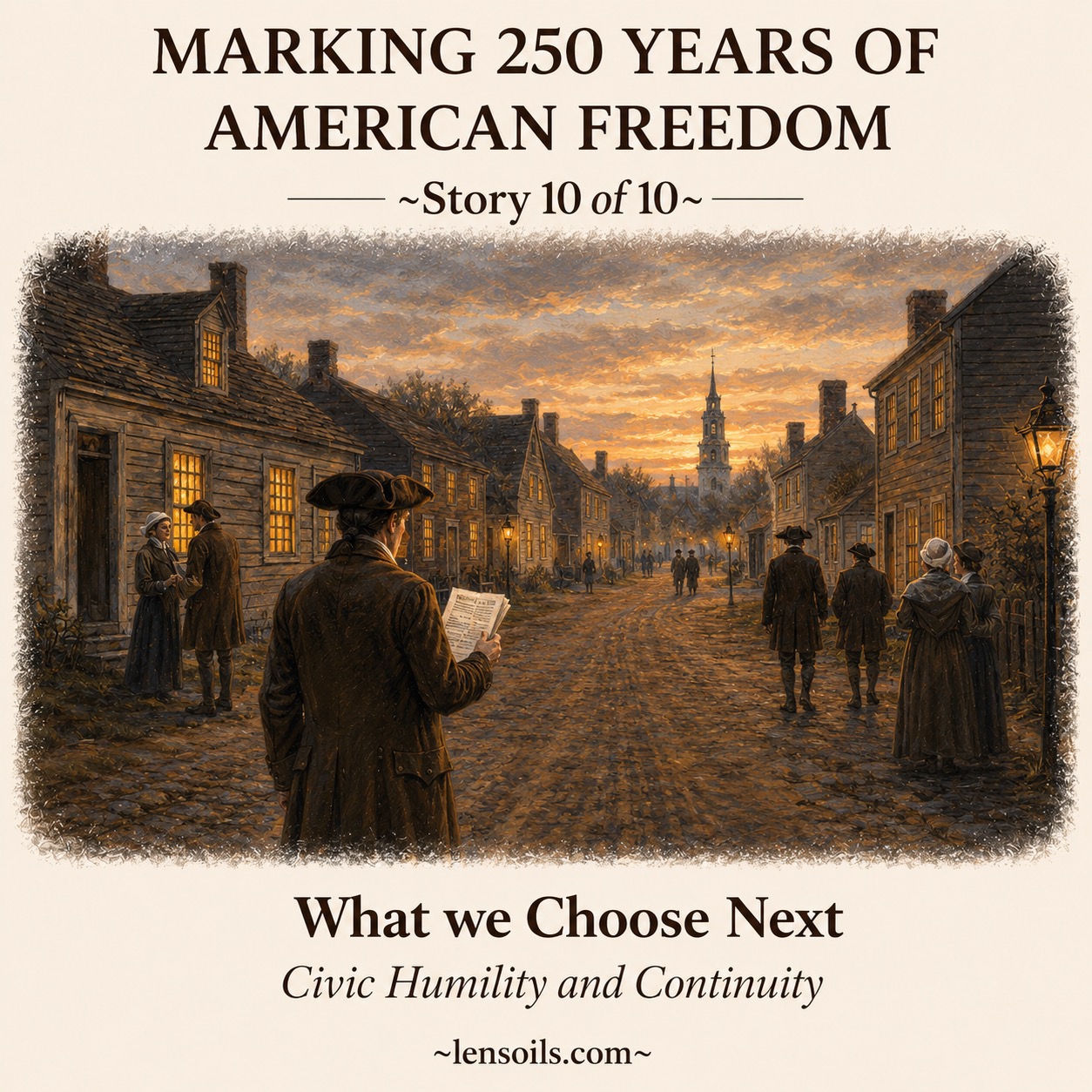
Story 10 of 10 — Marking 250 Years of American Freedom
Civic Humility and Continuity
By July 25, 1776, independence was no longer an announcement or a document. It had become a condition of daily life. Decisions made earlier that month were now shaping how towns governed themselves, how militias organized, and how neighbors related to one another. Authority shifted from distant rule to local responsibility, and the consequences of that shift were only beginning to be understood.
The Revolution did not end with the Declaration. It entered a new phase. Declaring independence did not remove disagreement or uncertainty. Instead, it transferred responsibility from protest to governance. Americans were now accountable not only for resisting British authority, but for building something durable in its place.
This transition required humility. The founders understood that independence did not guarantee wisdom, unity, or success. Mistakes would be made, and divisions would persist. Freedom offered opportunity, not perfection. It demanded patience, restraint, and a willingness to remain engaged even when outcomes were unclear.
Continuity mattered as much as change. Communities still needed laws enforced, disputes resolved, and defenses maintained. Independence did not excuse withdrawal or disorder. It required steady participation and trust built over time. The work of self-government depended on people choosing responsibility over retreat.
The burden of independence did not rest only with leaders or lawmakers. Ordinary citizens were now expected to act with judgment, to weigh personal conviction against shared stability, and to accept that freedom carried obligations as well as rights. Civic life became a daily practice rather than a distant ideal.
What distinguished this moment was not certainty, but commitment. Americans moved forward without knowing how the story would end. They chose to remain connected despite disagreement and to continue cooperating despite risk. Independence endured not because conflict disappeared, but because collapse was refused.
This is where the story remains unfinished. Independence is not preserved by ceremony or memory alone. It survives through discipline, humility, and the choice to live with difference without abandoning one another. What began in 1776 continues in every generation through what we choose next.
References
- Gordon S. Wood, The Radicalism of the American Revolution
- Bernard Bailyn, The Ideological Origins of the American Revolution
- Pauline Maier, American Scripture: Making the Declaration of Independence
These stories are grounded in documented historical events and primary sources, with limited interpretive synthesis used to connect facts and reflect lived experience where the historical record does not capture every detail.
 Len's Oils