“Health is not simply the absence of sickness… it’s also being able to bend over without making it a three-step process to get back up.”
—Meaning: true health means feeling capable and energetic, not just ‘not sick.’
“Health is not simply the absence of sickness… it’s also being able to bend over without making it a three-step process to get back up.”
—Meaning: true health means feeling capable and energetic, not just ‘not sick.’

Nine years ago, I was introduced to something that has transformed my life: essential oils.
Yes I was a big skeptic about them at first, but I now use essential oils on a daily basis in every area of my home, and they have completely changed my life! My medicine cabinet has been completely transformed, and I am now empowered with the tools and knowledge to care for my family.
When I realized I could get free products AND create residual income? I got really excited!
As a result, of my essential oil journey, and passion helping others, I’m ready to help you get started with your essential oil journey as well.
The best part about essential oils is that there is an option for everyone, whether you want to simply enjoy the products for yourself and transform your family’s health (and get free stuff in the process) OR you’re ready to build a team, create residual income, and get out of debt.
If any of these options sound appealing to you, let’s chat!
I’ll help you figure out which option will be the best fit for you, plus you can qualify for some awesome incentives in the process.
I can’t wait to talk to you!
I love sharing essential oils
Please text Free Sample or call me at 801-661-4786
I will be sure to get back to you as soon as possible.
Or
Send me an email at lfish64@yahoo.com
with the heading Free Sample
It will be an honor to help you in any way that I can.
Or
Write a letter requesting a Free Sample to
Leonard Fish
5075 Rushton Acres Court
West Valley City, Utah 84120
Sincerely,


“Pure as a child’s heart… until they discover glitter. Then may your oils help you find peace in the chaos.”
Purity and joy often shine brightest in life’s little messes.

Dr. Russell J. Osguthorpe, M.D., has dedicated more than 30 years to the healthcare field, beginning with his medical education at McGill University, followed by a pediatrics residency at The Children’s Hospital in Denver and a fellowship in pediatric infectious diseases at Washington University in St. Louis. These years of rigorous training laid the foundation for his lifelong commitment to patient care and advancing medical science. His early career was defined by service in children’s hospitals and clinics, where he specialized in diagnosing and treating complex infectious diseases, often caring for the most vulnerable patients.
For two decades, Dr. Osguthorpe played a key leadership role within Intermountain Healthcare, one of the nation’s most respected health systems. There, he served as Pediatric Medical Director and Department Chair at a tertiary care hospital, overseeing care delivery and building large multi-specialty practices. His leadership style emphasized collaboration, safety, and innovation, helping improve both outcomes and systems of care. During this period, he became widely respected as both a compassionate clinician and an effective administrator capable of guiding large medical teams through change.
In addition to his clinical and leadership duties, Dr. Osguthorpe has invested in academic medicine. He continues to serve as an Adjunct Associate Professor of Pediatrics at the University of Utah, where he has contributed to the training of future physicians and published research in pediatric infectious diseases. His studies on antimicrobial therapy in infants, cost and outcomes for febrile infant care, and case-based pediatric medicine reflect his dedication to evidence-based practice. These scholarly contributions demonstrate his dual commitment to improving patient outcomes and advancing medical knowledge for broader application.
In 2019, Dr. Osguthorpe expanded his career into the essential oils field by joining doTERRA as Chief Medical Officer and Vice President of Medical and Scientific Initiatives. This marked the beginning of his formal work with essential oils, adding to his already extensive medical background. At doTERRA, he has led efforts to integrate essential oils into modern healthcare, directing clinical trials, overseeing laboratory research, and supporting the development of evidence-based applications for essential oils. His work helps bridge the gap between traditional medicine and complementary approaches, aiming to validate and expand the role of essential oils in supporting wellness.
Today, Dr. Osguthorpe’s 30-plus years in healthcare encompass a unique blend of clinical expertise, hospital leadership, academic research, and integrative health innovation. Through his role at doTERRA, he continues to shape the future of healthcare by promoting a whole-person approach that includes both conventional medical practices and the use of essential oils. His vision focuses on empowering patients, enhancing preventive care, and fostering research that supports safer, more natural ways to improve health outcomes.

Cocoa essential oil, derived from the beans of the Theobroma cacao tree, is cherished for its deep, rich, and chocolate-like aroma. Native to Central and South America, cocoa has been celebrated for centuries as both a food and a symbol of love and vitality. In essential oil form, its scent provides comfort and indulgence, often used in blends to create a warm, cozy, and uplifting atmosphere. Diffused, it can evoke feelings of happiness and relaxation, much like enjoying a piece of chocolate without the calories.
Beyond its delightful fragrance, cocoa essential oil is packed with natural compounds that contribute to its soothing and antioxidant qualities. It is sometimes used in skin-care blends for its nourishing properties, helping to support smooth, healthy-looking skin. In aromatherapy, cocoa’s rich scent can help ease stress, encourage relaxation, and even promote a more grounded emotional state. Its luxurious aroma makes it a favorite in romantic blends and self-care rituals.
Did You Know? Ancient Mayan and Aztec civilizations revered cocoa as “food of the gods” and used it in rituals, drinks, and trade. Today, while most people know cocoa for chocolate, its essential oil form is less common and highly prized for natural perfumery and emotional wellness blends.

Dr. Josh Axe is a doctor of chiropractic, natural medicine, and clinical nutrition who has become one of the most recognized educators in holistic health and wellness. He founded DrAxe.com, which has grown into one of the world’s leading natural health websites, and co-founded Ancient Nutrition, a company focused on delivering history’s healthiest whole-food nutrients to modern consumers. His mission from the beginning has been to provide natural solutions to modern health challenges through food, lifestyle, and holistic practices.
Throughout his career, Dr. Axe has written multiple bestselling books, appeared on national television programs such as The Dr. Oz Show, and developed fitness programs like BurstFIT with his wife, Dr. Chelsea Axe. His professional success also extends into business, with Axe Wellness earning recognition on the Inc. 5000 list as one of the fastest-growing companies in the healthcare sector. His ability to combine clinical expertise with accessible education has made Josh Axehim a trusted authority in the natural health community.
In addition to his work in nutrition and functional medicine, Dr. Axe has been a prominent educator on essential oils and other natural remedies. His strong online presence—reaching millions of readers, viewers, and listeners—has positioned him as a leader in bringing holistic health into mainstream conversations. From dietary advice to natural approaches for fitness and well-being, his platforms have empowered people worldwide to take control of their health.
Dr. Axe’s personal health crisis marked a significant turning point in his philosophy. After suffering a severe back injury that developed into a spinal infection, he spent an entire year unable to walk. During this time, he faced despair and uncertainty, but ultimately discovered the power of “mindset medicine”—the belief that mental attitude, visualization, and faith play crucial roles in physical healing. His recovery reinforced his holistic approach, leading him to integrate mindset and spirituality alongside nutrition and lifestyle practices.
Today, Dr. Axe continues to lead DrAxe.com, Ancient Nutrition, and Leaders Media while also hosting The Dr. Josh Axe Show podcast. His most recent book, Think This, Not That (2024), reflects his evolved perspective on wellness, emphasizing the importance of breaking limiting beliefs and cultivating mental strength. Living between Nashville, Tennessee, and Puerto Rico with his wife Chelsea and their daughter Arwyn, Dr. Axe remains committed to helping people heal and thrive by blending natural medicine, mindset, and faith into a comprehensive vision of holistic wellness.

The Clementine Discovery
In an unlikely place—a quiet orphanage garden in North Africa—a new kind of citrus fruit was discovered. Among the familiar trees, one bore small, vibrant orange fruit with an unusually thin peel. Unlike other citrus, it was easy to open, bursting with sweetness, and often seedless. The children at the orphanage were the first to enjoy its refreshing juice and effortless peeling. Soon, word spread beyond the orphanage walls, drawing the attention of farmers and botanists who suspected it was a natural hybrid between a willow leaf mandarin orange and a sweet orange.
One person ensured this fruit would not be forgotten—Brother Clément Rodier, a French missionary who tended the orphanage’s gardens. Though he did not intentionally create the fruit, he recognized its value and formally classified it in 1902. As farmers realized its high yield and desirable taste, it spread rapidly. By the mid-20th century, it was grown in orchards across Spain, Morocco, and the United States, making it widely available. What started as a garden surprise had become one of the most beloved citrus fruits in the world.
Beyond its irresistible flavor, this fruit became known for its versatility. A few drops of its essential oil could help ease occasional heartburn when added to tea or water. Mixed into facial cleansers or shampoos, it helped promote healthy skin and hair. Its zesty essence was used in smoothies, desserts, and even cleaning products. Whether enjoyed as a snack, blended into a refreshing drink, or used for its cleansing properties, this little fruit had an impact far beyond the orphanage where it was first discovered. Today, it is known as Clementine, a citrus treasure enjoyed across the world, bringing joy, nourishment, and wellness to millions.

Patricia Davis: A Pioneer in Aromatherapy Education and Advocacy
Patricia Davis is a well-respected figure in the field of education and research, particularly in aromatherapy. She is best known for her book, Aromatherapy: An A-Z, which has become a widely used reference among practitioners. With years of experience in the study and application of essential oils, Davis played a key role in shaping modern aromatherapy practices. Her work focused not only on the benefits of essential oils but also on their safe and effective use, ensuring that both professionals and the general public could use them responsibly.
Davis’s interest in aromatherapy was driven by a passion for natural health and well-being. Throughout her career, she sought to bridge the gap between traditional herbal medicine and modern scientific research. By compiling detailed information on a wide range of essential oils, their properties, and their applications, she provided a reliable resource for practitioners, students, and enthusiasts. Her book remains one of the most trusted guides in the field, helping people make informed choices about essential oils.
One of Davis’s significant contributions was her emphasis on safety. At a time when essential oils were gaining popularity, misinformation was widespread, and many people used them without understanding their potential risks. Davis worked to educate the public on proper dilution methods, contraindications, and responsible usage. Her efforts helped establish guidelines that have since become standard in aromatherapy practice, preventing misuse and ensuring that essential oils are used in a way that promotes health rather than harm.
In addition to her writing, Davis was a strong advocate for public awareness of aromatherapy’s benefits. She conducted lectures, workshops, and training sessions to share her knowledge with both professionals and those new to the practice. By making complex scientific information accessible, she empowered individuals to incorporate essential oils into their daily lives safely and effectively. Her ability to communicate technical details in a clear and engaging manner made her an influential educator in the field.
Davis also played a role in fostering a more evidence-based approach to aromatherapy. She encouraged further research into the therapeutic effects of essential oils, advocating for scientific studies that could validate traditional knowledge. While much of aromatherapy was historically based on anecdotal evidence, Davis believed that integrating research-based findings would strengthen the field and increase its credibility within the medical and scientific communities.
Her contributions extended beyond her book. Davis collaborated with various organizations and practitioners to promote ethical sourcing and sustainability in the production of essential oils. She emphasized the importance of using high-quality, pure essential oils and warned against synthetic additives or low-quality products that could compromise the therapeutic effects. This advocacy helped set higher industry standards and encouraged responsible practices in the essential oil market.
Although much of Davis’s work was centered on essential oils, her broader impact was in holistic health education. She supported a balanced approach to wellness, integrating aromatherapy with other natural therapies such as massage, herbal medicine, and mindfulness practices. Her approach was holistic, recognizing that true well-being involves physical, emotional, and mental health. This perspective resonated with many practitioners and contributed to the growing acceptance of complementary and alternative medicine.
Patricia Davis resides in the Southwest of England, where she has dedicated many years to the practice and teaching of aromatherapy. Beyond her professional endeavors, she has authored several best-selling books, including Subtle Aromatherapy, A Change for the Better, and Astrological Aromatherapy. While specific details about her personal life remain private, her extensive work and publications reflect a deep commitment to holistic health and natural therapies.
Patricia Davis’s legacy continues to influence the field of aromatherapy today. Her dedication to education, research, and public awareness has left a lasting mark, ensuring that essential oils are used knowledgeably and safely. Aromatherapy: An A-Z remains a valuable resource for both beginners and experienced practitioners, a testament to her lifelong commitment to sharing accurate, well-researched information about the power of essential oils.
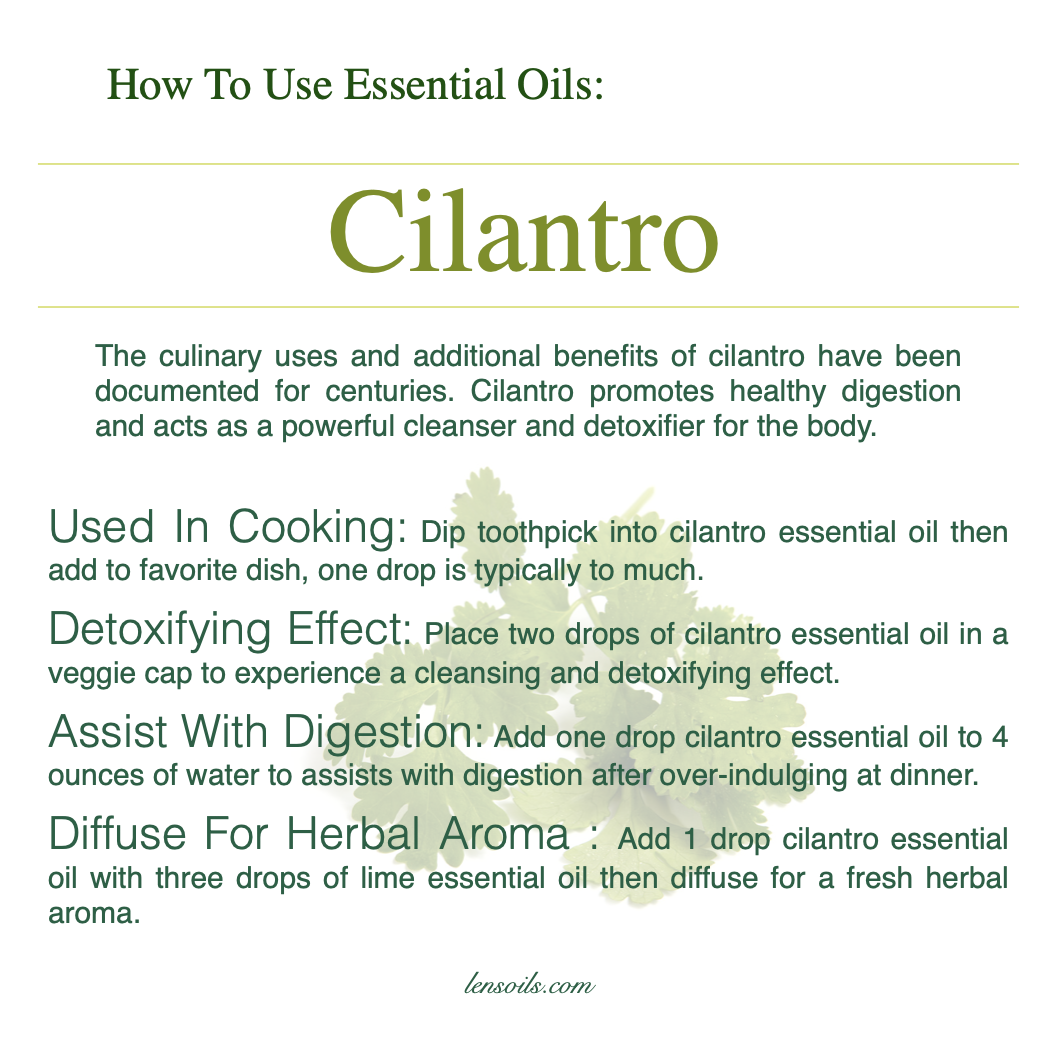
Cilantro (Coriandrum sativum) has been used in culinary and medicinal traditions for centuries, valued for both its distinctive flavor and health-supporting properties. Known for its fresh, herbaceous aroma, cilantro is widely used in cooking, particularly in Mexican, Middle Eastern, and Asian cuisines. The essential oil, derived from cilantro leaves, is highly concentrated, and a small amount goes a long way. A common method for culinary use is dipping a toothpick into cilantro essential oil and stirring it into dishes, as even one full drop may be too strong. Beyond its culinary appeal, cilantro essential oil is believed to promote digestion and help detoxify the body. Some practitioners suggest placing two drops of cilantro essential oil in a veggie capsule to support natural cleansing processes. While cilantro has been traditionally used for detoxification, more scientific studies are needed to validate its direct impact on heavy metal removal and long-term detox benefits.
Cilantro essential oil is also frequently used for digestive support. Many individuals add one drop to four ounces of water to assist digestion after a heavy meal, a practice based on cilantro’s traditional use in easing bloating and occasional stomach discomfort. Additionally, diffusing one drop of cilantro essential oil with three drops of lime essential oil can create a refreshing herbal aroma, often used to promote a sense of freshness and mental clarity. Some aromatherapists believe that cilantro’s invigorating scent may also contribute to emotional balance and stress reduction. While these benefits are widely supported by holistic wellness practices, further clinical research is required to fully understand cilantro essential oil’s physiological effects on digestion and mood enhancement.
Beyond its culinary and detoxifying properties, cilantro essential oil is being explored for its potential antibacterial and antimicrobial effects. Some studies suggest that cilantro oil contains compounds that may help inhibit certain bacteria, making it a potential natural preservative. It has also been traditionally used in folk medicine for immune support, though its efficacy compared to standard antimicrobial treatments remains an area of study. Despite these uncertainties, cilantro essential oil remains a highly versatile oil, offering culinary, digestive, and aromatic benefits, making it a valuable addition to natural wellness practices.

Please text Free Sample or call me at 801-661-4786
I will be sure to get back to you as soon as possible.
Or
Send me an email at lfish64@yahoo.com
with the heading Free Sample
It will be an honor to help you in any way that I can.
Or
Write me a letter, request a Free Sample

Leonard Fish
5075 Rushton Acres Court
West Valley City, Utah
84120 USA
 Len's Oils