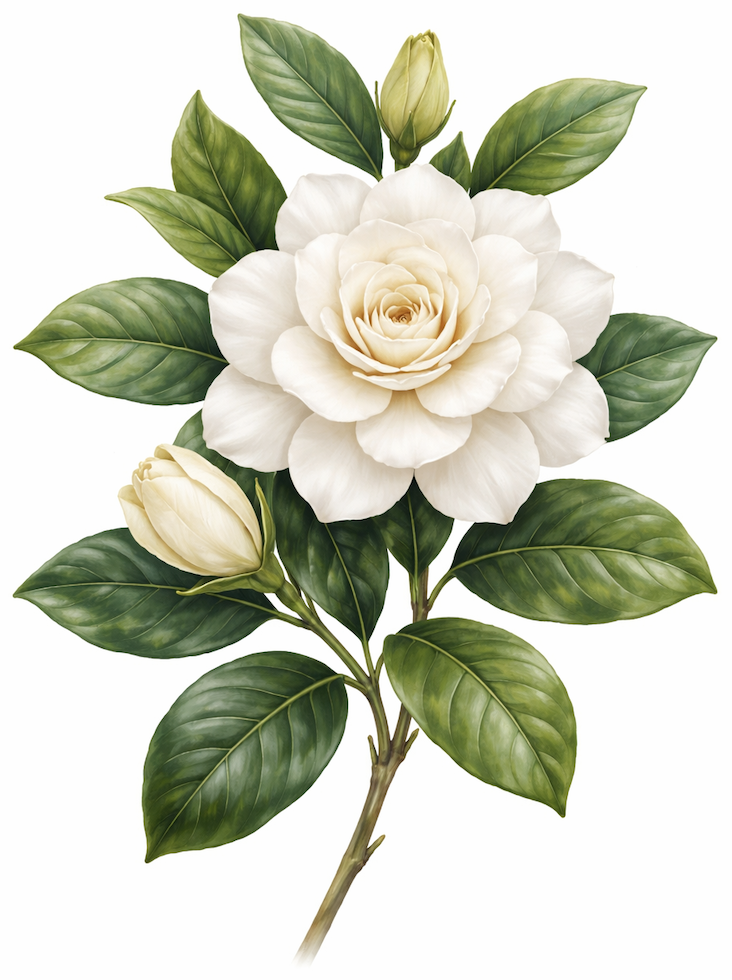
He was not a celebrity scientist, nor a professor whose name filled lecture halls. He was a careful botanist who preferred pressed specimens to applause. While others chased recognition, he chased patterns in petals and the quiet order hidden in leaves. Plants, he believed, carried stories that only patient eyes could read—if someone would stand still long enough to notice.
In a humid region of East Asia, he studied an evergreen shrub long known in cultivated landscapes. It did not surrender its leaves to winter. Its foliage remained deep green and glossy throughout the year, thriving best in warmth, moisture, and slightly acidic soil. He recorded its habits faithfully, page after page, season after season.
When buds formed, he observed them daily. They began tightly folded, pale and waxy, then slowly opened into layered petals arranged in a natural spiral. He sketched their symmetry carefully, aware that nature often reveals mathematical precision long before humans attempt to define it.
The fragrance was unmistakable. Rich and creamy, often compared to jasmine, it drifted through the air with quiet authority. He paused the first time he inhaled it fully. Some scents impress. This one lingered. He understood why the blossoms had long been treasured across Asia and later admired in Western perfumery.
Though known for centuries in Asia, the plant entered Western scientific records during the age of classification. European botanists began assigning Latin names to species already familiar to other cultures. Documentation and taxonomy gave structure to what tradition had already preserved in gardens and courtyards.
The genus was named in honor of Dr. Alexander Garden, an 18th-century Scottish physician and naturalist who corresponded with Carl Linnaeus. Garden did not discover the plant in Asia, but his contributions to botanical study earned recognition in the naming tradition of that era—a quiet tribute from one student of nature to another.
Extracting fragrance from the flower proved difficult. Its delicate petals do not easily yield oil through simple steam distillation. Careful extraction methods were required to preserve its aromatic compounds, allowing perfumers to capture the bloom’s creamy floral depth without losing its character.
In traditional settings, the blossoms symbolized purity and quiet strength. They were placed in homes and gardens, admired not only for beauty but for the atmosphere they created. The botanist once wrote that some plants do more than grow—they shape the space around them in ways science cannot fully measure.
Modern aromatic use requires proper dilution and thoughtful handling. When blended carefully with a carrier oil, floral extracts may be included in massage or personal routines—sometimes diluted for skincare, blended for massage, lightly applied to pulse points, or diffused for peace. Even now, its fragrance continues to move gently through modern homes.
And the evergreen shrub native to East Asia, classified in the 18th century, named in honor of Alexander Garden, admired for its spiral blossoms and creamy fragrance is Gardenia. A flower of symmetry and science. And now you know the rest of the story.


 Len's Oils